

Frequently Asked Questions
At a glance
Straight answers on choosing spill kits, bunding, ISO 14001 audits, servicing, delivery and training, from an Australian owned environmental compliance supplier.
20
Buyer questions answered
11 am
Order cut-off for same-day dispatch
100%
Australian owned and operated
1300 912 949
Talk to the team
Choosing a spill kit
What goes in a spill kit?
A spill kit contains absorbents to soak up the liquid, personal protective equipment for the responder, and containment and disposal items to bag and remove the waste, all held in one labelled container.
Akuna’s spill control range covers absorbent pads, rolls, socks, pillows, booms and wipes, floor sweep, spill mats, personal protective equipment and spill kit extras such as shovels. Kits can be topped up from the workplace refill and vehicle refill ranges once used. Kit contents vary by type, so check the individual kit listing for what is packed in the one you are buying.
1
Absorbents
Soak up the liquid. Pads, rolls, socks, pillows, booms, wipes and floor sweep.
2
Personal protective equipment
Protects the responder while the spill is contained and cleaned up.
3
Containment and disposal
Bags and extras such as shovels to collect and remove the waste.
All three are held in one labelled container. Contents vary by kit type, so check each listing.
What size spill kit do I need?
A spill kit is sized to the largest single volume of liquid that could escape in one event, measured by the kit’s absorbent capacity rather than the size of its bin.
A 240 litre bin does not mean 240 litres of absorbency. Walking distance matters too: several smaller kits placed near each risk point usually outperform one large kit in a store room. Akuna’s workplace kits run from 25 litre vehicle bags through 140 litre and 240 litre units. An environmental risk assessment will size the kit against the liquids a site actually holds.
Three steps to size a kit
- Find the largest single volume of liquid that could escape in one event.
- Match the absorbent capacity to that volume, not the size of the bin.
- Place kits near each risk point so a responder reaches one fast.
Akuna kit formats by container size
Remember: a 240 litre bin does not mean 240 litres of absorbency.
What is the difference between an oil, chemical and universal spill kit?
Oil and fuel spill kits absorb hydrocarbons and repel water, chemical spill kits are rated for acids, alkalis and reactive chemistry, and universal spill kits handle mixed or unknown liquids.
Because oil only absorbents shed water, an oil and fuel kit still works on wet ground and on open water. A chemical kit uses absorbents that stay inert against aggressive liquids. A universal kit covers general purpose duty including water-based liquids and coolants. Akuna stocks Chemical, Oil and Fuel, Universal, Oil and Fuel Marine and Oil and Fuel Vehicle kits, plus economy versions of the oil and universal ranges. Choose from the safety data sheets for the liquids on site, not from a catalogue.
| Kit type | What it absorbs | Works on wet ground or water? | Akuna range |
|---|---|---|---|
| Oil and fuel | Hydrocarbons. Repels water. | Yes, the absorbent sheds water | Oil and Fuel, Oil and Fuel Marine, Oil and Fuel Vehicle, plus economy versions |
| Chemical | Acids, alkalis and reactive chemistry. Absorbent stays inert. | Rated for aggressive liquids | Chemical |
| Universal | Mixed or unknown liquids, including water-based liquids and coolants | General purpose duty | Universal, plus economy versions |
Choose from the safety data sheets for the liquids on site. Compare Akuna spill kits.
Do I need a spill kit or a bund?
Most sites need a spill kit and a bund, because the two do different jobs.
A bund is passive containment that holds a leak inside a defined area before it spreads, and a spill kit is the active response used once liquid is already on the ground. Bunding is generally expected wherever bulk liquids are stored, and a spill kit covers decanting, transfer, plant movements and vehicle traffic around that storage. Akuna supplies both sides: bunded pallets, floor bunding, collapsible bunds, containment walls, spill decks, berms, spill trays, drum funnels and overpack drums for containment, and the full spill kit range for response.
Bund
Passive containment
- Holds a leak inside a defined area before it spreads
- Generally expected wherever bulk liquids are stored
- Bunded pallets, floor bunding, collapsible bunds, containment walls, spill decks, berms, spill trays, drum funnels and overpack drums
Spill kit
Active response
- Used once liquid is already on the ground
- Covers decanting, transfer, plant movements and vehicle traffic
- The full Akuna spill kit range
Most sites need both, because the two do different jobs.
How many spill kits does a site need and where should they go?
A site needs one spill kit at every point where a spill could start, placed close enough that a responder can reach it and return before the liquid spreads.
In practice that means one kit at each bulk storage or decanting point, one in each workshop or plant area, and one in every vehicle that carries liquids. Keep each kit accessible, out of direct sunlight and away from extreme temperatures so the absorbents and packaging do not degrade, and sign its location so a new starter or a contractor can find it. An environmental risk assessment will set the number and the placement for a specific site.
Spill kit placement checklist
- One kit at each bulk storage or decanting point
- One kit in each workshop or plant area
- One kit in every vehicle that carries liquids
- Accessible, with nothing blocking the way
- Out of direct sunlight and away from extreme temperatures
- Location signed for new starters and contractors
Compliance and audits
What spill equipment do I need to pass an ISO 14001 audit?
An ISO 14001 auditor looks for spill response as a working operational control, which means the right kit for the liquids on site, containment where bulk liquids are stored, a current inspection record and training records.
The equipment on its own does not close a finding. What closes it is the paper trail beside the equipment: the kit matched to the substances on the safety data sheets, bunding where it is needed, an inspection register that is up to date, and training records for the people expected to respond. Akuna’s spill response training is built around ISO 14001 compliance requirements, and the spill kit servicing program produces the inspection record an auditor asks for.
What an ISO 14001 auditor looks for
1
Kit matched to the substances on the safety data sheets
2
Bunding where bulk liquids are stored
3
An up to date inspection register
4
Training records for the people expected to respond
The equipment alone does not close a finding. The paper trail beside it does.
What are my legal obligations for spill response in Australia?
Australian law does not name a spill kit and order a business to buy one.
Australian law imposes two duties instead, and together they make a kit the practical answer: a work health and safety duty to manage the risk of hazardous chemicals, and an environmental duty not to cause pollution or harm.
The work health and safety duty requires spills to be contained and cleaned up in the area where the chemicals are used, handled or stored, and requires an emergency plan with trained people behind it. The environmental duty sits with the state regulator and is enforced separately, so a spill that reaches a drain or a waterway can be an offence even where nobody is hurt. Which regulator applies depends on the state.
Duty 1
Work health and safety
Manage the risk of hazardous chemicals: contain and clean up spills where chemicals are used, handled or stored, with an emergency plan and trained people.
Duty 2
Environmental protection
Do not cause pollution or harm. Enforced separately by the state regulator, so a spill that reaches a drain or waterway can be an offence even where nobody is hurt.
The practical answer: the right spill kit, containment and trained responders.
What does a spill risk assessment involve?
An Akuna environmental risk assessment identifies a site’s existing and potential environmental risks, so spill kits, bunding and containment are specified against real exposures rather than guesswork.
Akuna describes its approach as a cycle: assess the current situation, plan a course of action, deliver and install the products required, provide training in their safe and compliant use, then service them to maintain performance. The assessment is the first step in that cycle.
1
Assess
Current situation2
Plan
Course of action3
Deliver
Supply and install4
Train
Safe, compliant use5
Service
Maintain performanceThe assessment is step one of the cycle. Book an environmental risk assessment.
How often should spill kits be serviced and restocked?
Spill kits should be inspected on a set cycle, with every inspection recorded, and restocked immediately after any use however small.
Akuna publishes a free spill kit inspection checklist covering contents, absorbent condition, personal protective equipment, containment and disposal items, location, access and labelling. Sites that would rather not run the checks in house can use the spill kit servicing and maintenance program, which covers supply, auditing and management across a whole site and guarantees kits are fully stocked, maintained and ready for any incident.
What a spill kit inspection covers
- Contents
- Absorbent condition
- Personal protective equipment
- Containment and disposal items
- Location
- Access
- Labelling
- Restock immediately after any use
Products and installation
What is a bunded pallet and when is it required?
A bunded pallet is a pallet with a built-in sump underneath, so a drum or IBC standing on it leaks into the sump instead of onto the ground.
Akuna supplies two and four drum bunded pallets for standard 200 litre drums, with safe working loads of 500 kilograms and 1,000 kilograms, and IBC bunded pallets at safe working loads of 1,650 and 3,200 kilograms. They are designed and manufactured to meet Australian work health and safety regulations and environmental protection laws. Secondary containment is expected wherever bulk liquids are stored, and the required sump capacity is set by the volume held and the standard that applies to the substance.
| Bunded pallet | Holds | Safe working load |
|---|---|---|
| Two drum | Standard 200 litre drums | 500 kg |
| Four drum | Standard 200 litre drums | 1,000 kg |
| IBC | Intermediate bulk container | 1,650 kg |
| IBC | Intermediate bulk container | 3,200 kg |
Do you install floor bunding and DrainSafe?
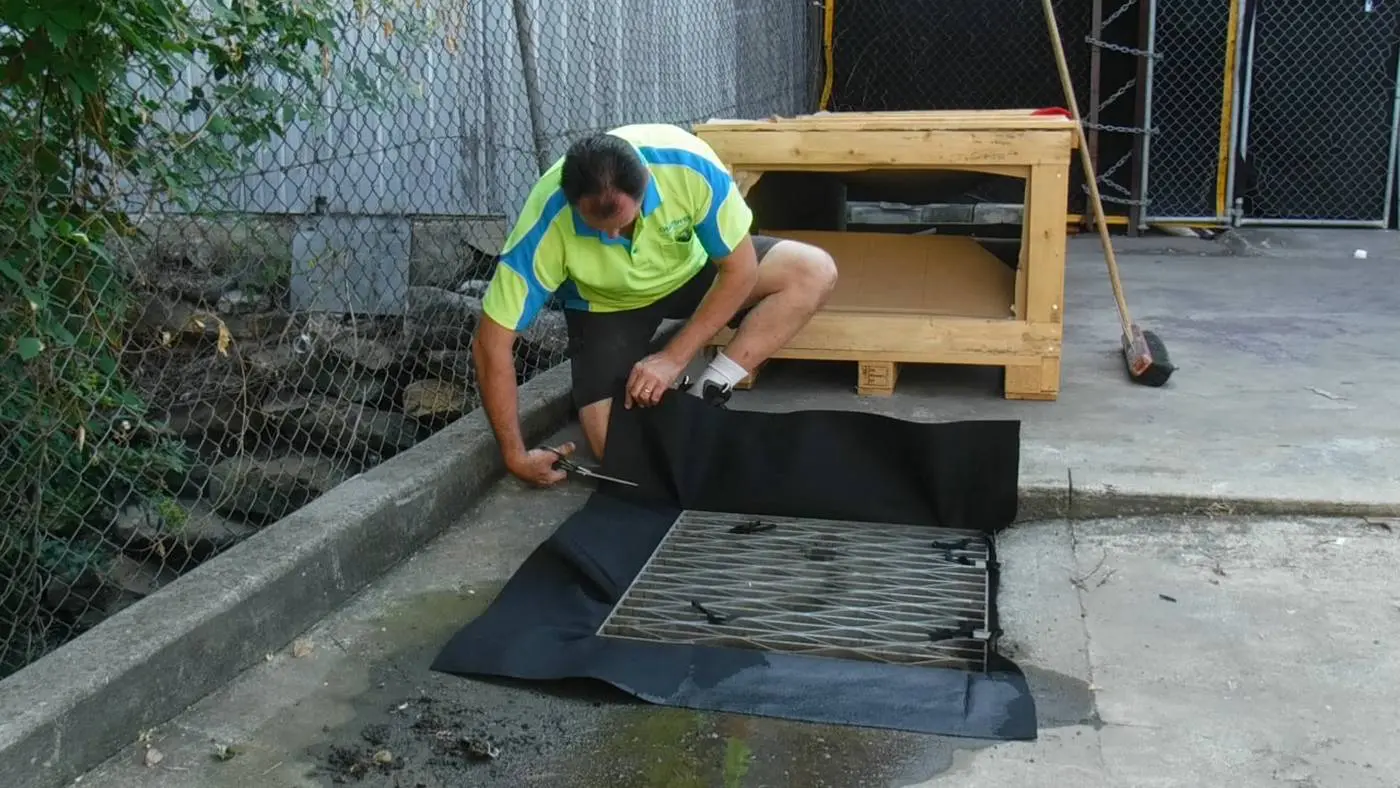
Yes, Akuna provides in-house installation for DrainSAFE, floor bunds, silt curtains, drain wardens, containment booms, and eyewash and safety showers.
Floor bunding is also straightforward to install in house: the flexible floor bunding and the other options come with pre-formed anchor points and installation kits. Akuna stocks aluminium, EVA, flexible and urethane floor bunding, plus the sealant to finish the job. DrainSAFE is a stormwater isolation and pollution prevention device, supplied in a range of sizes and configurations.
Akuna in-house installation
Floor bunding options: aluminium, EVA, flexible and urethane, with pre-formed anchor points, installation kits and sealant.
What is a dewatering bag and when do you use one?
A dewatering bag is a geotextile filter bag that pumped, sediment-laden water is discharged into, so the solids stay inside the bag and cleaner water passes out through the fabric.
A dewatering bag is used whenever water is pumped out of an excavation, trench, pit, cofferdam or sediment basin and cannot be discharged straight to a drain or a waterway. Akuna’s bags are fabricated from 260 gsm geotextile and come in multiple sizes, with a double thickness neck and double stitching for strength. A bag reliably retains sand and gravel; it will not retain silt or clay, which need settlement or flocculation instead.
Use one when pumping water from
ExcavationsTrenchesPitsCofferdamsSediment basins
Akuna bags: 260 gsm geotextile, multiple sizes, double thickness neck, double stitching.
What a dewatering bag retains
- Sand retained
- Gravel retained
- Silt not retained, needs settlement or flocculation
- Clay not retained, needs settlement or flocculation
What is a silt curtain and when is it required?
A silt curtain, also called a turbidity curtain, is a floating barrier hung in the water to stop silt, sediment, fine particles and contaminants spreading into the surrounding waterway.
A silt curtain is used on construction, dredging and shoreline projects near water, and it protects water quality and aquatic ecosystems while the works are underway. Akuna stocks Class 1 and Class 2 curtains, each with a 1 metre or 2 metre skirt, in plain and connected versions, along with connector kits, a tow bridle and marine grade stainless steel wire rope. Akuna also installs silt curtains.
| Curtain | Skirt depth | Versions |
|---|---|---|
| Class 1 | 1 metre or 2 metre | Plain and connected |
| Class 2 | 1 metre or 2 metre | Plain and connected |
| Accessories | Connector kits, tow bridle, marine grade stainless steel wire rope | Installation available |
Used on construction, dredging and shoreline projects near water. View silt curtains.
Buying, delivery and service area
Do you deliver Australia wide?
Yes, Akuna is an Australian owned company based in New South Wales that supplies sites Australia wide, and orders placed before 11 am are dispatched the same day.
Delivery options and rates vary with the delivery address and the order, and are calculated at checkout. For a bulk, custom or specified order, use the request a quote form or call 1300 912 949 and the team will work through quantities and freight.
11 am
Order before 11 am for same-day dispatch
Australia wide
Products shipped to sites nationwide
Pendle Hill
Click and collect from our NSW base
What is your returns and refund policy?
Akuna’s policy is that damaged or faulty goods must be reported within seven days of delivery with a photograph, and that refunds are not offered for change of mind.
An exchange may be offered at Akuna’s discretion where the customer notifies within three business days of delivery and returns the goods in their original condition and original packaging, with return delivery fees at the customer’s expense. Separately, Akuna’s goods come with guarantees that cannot be excluded under the Australian Consumer Law, including a replacement or refund for a major failure, and repair or replacement where goods are not of acceptable quality.
Delivery
The timeframes below start from the day the goods are delivered.
Within 3 business days
Notify to request an exchange. Goods in original condition and packaging, return delivery at customer cost. Offered at Akuna’s discretion.
Within 7 days
Report damaged or faulty goods with a photograph.
Always
Australian Consumer Law guarantees apply and cannot be excluded.
No refunds for change of mind. Full terms: Terms and Conditions.
Which areas do you cover for installation, servicing and training?
Akuna ships products Australia wide, runs spill response training at Sydney metro locations, and delivers the toolbox talk on the customer’s own site.
For installation and for spill kit servicing, coverage depends on the site and the scope of work, so call 1300 912 949 to confirm whether a location is serviced.
| Service | Where it is delivered |
|---|---|
| Products | Shipped Australia wide |
| Spill response training | Sydney metro locations |
| Toolbox talk | On the customer’s own site |
| Installation | Depends on site and scope, call to confirm |
| Spill kit servicing | Depends on site and scope, call to confirm |
Training
Where do you run spill response training and what does it cost?
Akuna’s spill response training runs at Sydney metro locations on weekdays during business hours, as a 60 to 90 minute practical session priced per session on quote.
The session teaches staff to identify and assess spill hazards, safely contain and clean up chemical and oil spills, execute emergency response procedures, meet ISO 14001 compliance requirements and minimise environmental risk. Programs cover chemical spill response, oil spill response and general spill response, and the session suits all experience levels. Pricing depends on the group and the site, so call 1300 912 949 for a quote.
What staff learn in the session
- Identify and assess spill hazards
- Safely contain and clean up chemical and oil spills
- Execute emergency response procedures
- Meet ISO 14001 compliance requirements
- Minimise environmental risk
- Chemical, oil and general spill response programs
Can training be delivered on site and online?
Akuna delivers training on site as a 30 minute toolbox talk refresher, and does not currently offer an online or virtual option.
The toolbox talk covers what counts as an emergency spill incident, environmental legislation and compliance, the seven step spill response guide, and an overview of spill response products. It suits all personnel and is built around ISO 14001 and legislative compliance requirements. The longer spill response training workshop runs at Sydney metro locations rather than on the customer’s site.
| Spill response training | Toolbox talk | |
|---|---|---|
| Length | 60 to 90 minutes | 30 minutes |
| Where | Sydney metro locations | On your site |
| Format | Practical session | Refresher |
| Covers | Hazard assessment, containment and clean-up, emergency procedures, ISO 14001 | Emergency spill incidents, legislation and compliance, the seven step spill response guide, product overview |
| Online option | No | No |
| Price | Per session, on quote | Call 1300 912 949 |
Servicing
Do you offer on-site spill kit servicing and inspections?
Yes, Akuna’s spill kit servicing and maintenance program covers the supply, auditing and management of spill kits across a whole site, so kits stay fully stocked, maintained and ready for any incident.
Akuna describes the program as a tool for work health and safety management and due diligence that also lifts staff knowledge of spill response, and regular staff training and toolbox talks can be bundled with it. It is offered as a cost-effective alternative to managing kits internally.
The servicing program covers
- Supply of spill kits across the site
- Auditing of kits already held
- Ongoing management of kits
- Kits stocked, maintained and incident ready
- Optional staff training and toolbox talks
- Support for WHS management and due diligence
Can you assess my site before an audit?
Yes, Akuna can assess a site before an audit: an environmental risk assessment identifies what is exposed, and the spill kit servicing program audits the kits already held.
Between the two, a site gets a view of what is exposed and what is short: the liquids and locations that need containment or a kit, and the kits that are under-stocked, expired or in the wrong place. Akuna then supplies and installs what is required and can train the people using it. Call 1300 912 949 or use the contact form to book an assessment.
Ready to get your site compliant?
1Shop spill kitsOil and fuel, chemical, universal, marine and vehicle kits.
Shop the range → 2Book a site assessmentSpecify kits and bunding against your real exposures.
Book an assessment → 3Book a spill kit serviceInspection, restocking and the records auditors ask for.
Book a service → 4Book spill response trainingPractical ISO 14001 aligned sessions, Sydney metro.
Book training →
Shop the range → 2Book a site assessmentSpecify kits and bunding against your real exposures.
Book an assessment → 3Book a spill kit serviceInspection, restocking and the records auditors ask for.
Book a service → 4Book spill response trainingPractical ISO 14001 aligned sessions, Sydney metro.
Book training →