
Silt Curtains
Showing the single result
-
Silt Curtain
Price range: $16.50 through $1,644.50 (inc. GST)
Extra Information
Silt Curtains
Durable Silt Curtains for Australian Waterways
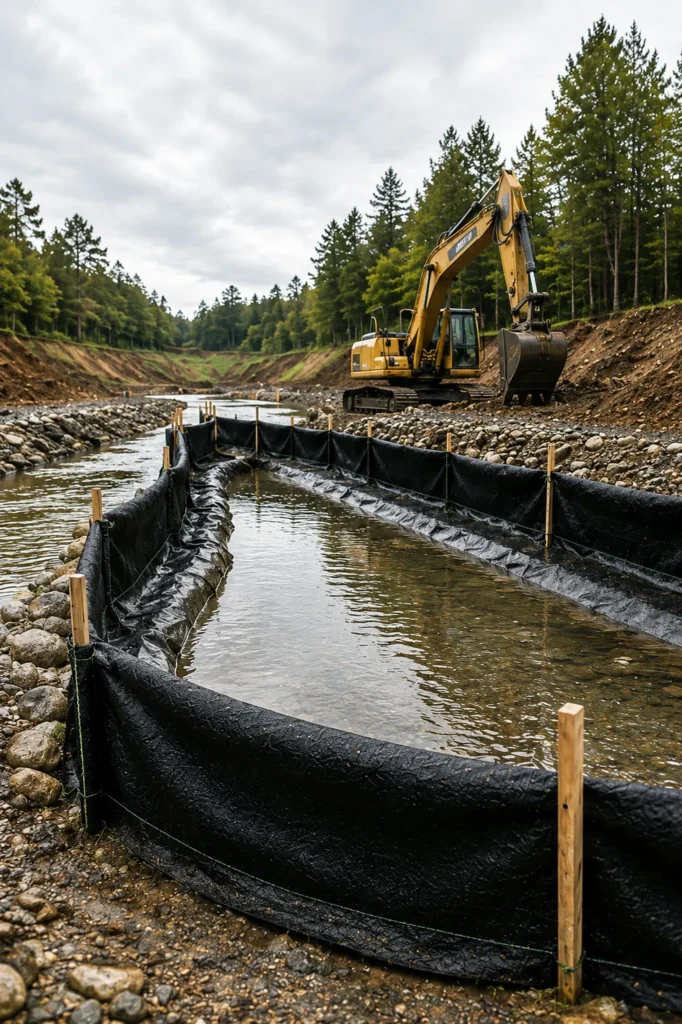
Silt curtains are floating barriers that hang below the waterline to contain suspended sediment and hold turbidity inside a defined work zone. They do not filter water: they stop the current carrying the plume away, so particles settle inside the enclosure rather than drifting downstream.
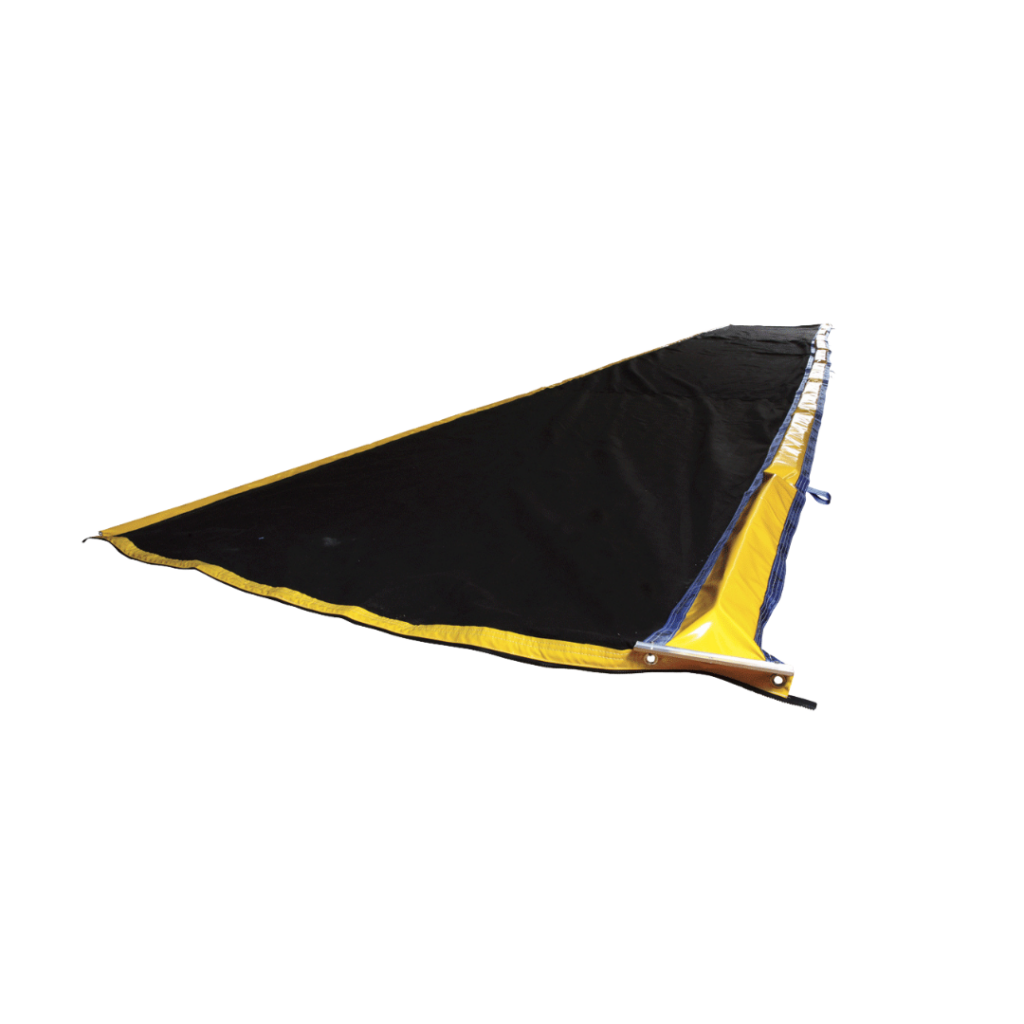
Akuna Services supplies silt curtains Australia wide, specified against water depth, current and job duration. Ours use reinforced PVC coated fabric, a sealed floatation collar and a galvanised ballast chain, so the skirt hangs vertically rather than kiting under load.
11 am
Australia wide delivery, same day dispatch before 11 am
Type 1, 2, 3
Type 1, Type 2 and Type 3 curtains for calm, moving and tidal water
Custom
Custom lengths and skirt depths made to your drawing
80%
Skirt depth as a share of water depth
On this page
- 01What a Silt Curtain Does and When It Is Required
- 02Our Range of Type 1, Type 2 and Type 3 Silt Curtains
- 03Floatation, Ballast Chain and Skirt Construction
- 04Custom Lengths and Depths Made to Your Project
- 05Silt Curtains for Rivers, Lakes, Harbours and Dams
- 06Dredging, Piling and Marine Construction Works
- 07Containing Turbidity and Protecting Aquatic Habitat
- 08Meeting Erosion and Sediment Control Plan Requirements
- 09Built to Be Retrieved, Cleaned and Reused
- 10Matching Curtain Depth to Water Depth and Current
- 11FAQs
What a Silt Curtain Does and When It Is Required
A curtain works on settlement. Enclose a dredge head or a piling rig and the water inside is stilled, giving fine particles time to fall to the bed. Turbidity inside stays high; water crossing the boundary stays near background.
The trigger is almost always a condition of approval. A consent, a marine works permit or a licence under state environment protection legislation will nominate a turbidity limit at a compliance point and require a barrier. You need one when:
- Dredging, excavation, piling or pile extraction occurs below the waterline
- Rock armour or scour protection is placed in a channel
- Seagrass, aquaculture or a potable intake sits downstream
Our Range of Type 1, Type 2 and Type 3 Silt Curtains
Curtains are classified by the water they sit in. The wrong type is the costliest error on an in-water job: a calm water curtain in a tidal channel will lift, kite and tear at the seam.
| Type | Water condition | Typical current | Construction | Typical application |
|---|---|---|---|---|
| Type 1 | Calm, non-tidal | Under 0.25 m/s | Light chain, standard seam | Ponds, dams, basins |
| Type 2 | Moving, mild tidal | 0.25 to 0.5 m/s | Heavier chain, reinforced seam | Rivers, canals, harbours |
| Type 3 | Tidal, exposed | Above 0.5 m/s | Heavy chain, twin load lines | Open harbours, estuaries |
Our silt curtain is configurable, so skirt depth, panel length and hardware suit the site rather than one fixed size. Where a job sits between two classes, specify up.
Floatation, Ballast Chain and Skirt Construction
The floatation collar is closed cell foam sealed in a sleeve at the head. It does not waterlog, so the curtain holds freeboard through a long deployment and sits proud enough to stop the plume washing over.
The skirt is reinforced PVC coated fabric, welded or double stitched and hemmed top and bottom. Being impervious, it forces water around the barrier. Geotextiles in sediment control are commonly tested to the AS 3706 series, and seam tear strength is where a loaded curtain fails first.
The ballast chain runs galvanised chain through the bottom hem, holding the skirt vertical and carrying tension along a continuous load line.
Custom Lengths and Depths Made to Your Project
Few work areas match a catalogue length. A boat ramp reconstruction might need 45 metres with a 3 metre skirt; a harbour dredging campaign needs 400 metres in Type 3 with a 9 metre skirt.
To quote we need the plan length, the depth at its deepest point, the peak current or tidal range, the duration, and whether the curtain moves as work advances.
Worked example
- Order generously: deploy in a shallow arc with 10 to 15 per cent more length than the straight line distance.
- A 100 metre crossing takes 110 to 115 metres.
Silt Curtains for Rivers, Lakes, Harbours and Dams
Rivers and creeks. Flow is unidirectional and rises with rainfall. Curtains are set at an angle to it, so the current sweeps the plume along the barrier face towards a settling zone.
Lakes, dams and sediment basins. Calm water and long deployments, so Type 1 is generally adequate and the priority shifts to UV stability. Floating baffles are often used in the same basin to lengthen the flow path.
Harbours and estuaries. Flow reverses twice daily, so the anchoring must hold through the turn and tidal range changes freeboard and bed clearance. Where a barrier must also manage vessels, see marine barriers.
Dredging, Piling and Marine Construction Works
Dredging produces the largest plume of any in-water activity, so the curtain is normally a full enclosure around the dredge footprint with a gate for plant access. Size it so the dredge works a full shift without the barrier moving: repositioning mid shift is where most damage happens.
Piling releases sediment in short pulses, so the curtain is usually a smaller cell around the rig, advanced along the pile line. Our customers here are civil contractors, local government asset teams, utilities, mining operations and port authorities. Where land side disturbance runs alongside, the site also needs silt sock controls.
Containing Turbidity and Protecting Aquatic Habitat
Suspended sediment does its damage three ways: it cuts light penetration and stresses seagrass, it abrades fish gills and smothers filter feeders, and on settling it blankets benthic habitat and spawning gravels.
Containment is measured, not assumed.
Worked example
- If background is 12 NTU and the consent allows background plus 25 NTU at 50 metres:
- Your limit is 37 NTU.
A climbing reading usually means a lifted skirt or a curtain too shallow for the tide. Fine silt around 20 microns settles slowly, so opening a curtain straight after work stops releases the plume you just contained.
Meeting Erosion and Sediment Control Plan Requirements
Your erosion and sediment control plan should name the curtain three times: on the drawing with alignment and type, in the installation notes with depth and anchoring, and in the inspection schedule with a frequency and owner.
For the paper trail, hold the following for the life of the works:
- 1Product specification: type, skirt depth, length
- 2Dated installation record with photographs of the deployed barrier
- 3Inspection records, weekly minimum and after every rainfall event
- 4Turbidity results at the nominated compliance point
- 5Decommissioning record showing recovery date and sediment disposal
General environmental duty provisions and the duty to control risk under the WHS Regulations 2011 sit behind this. An auditor wants evidence the control matched the risk and was installed, checked and recorded.
Built to Be Retrieved, Cleaned and Reused
A silt curtain is capital equipment, not a consumable. Reinforced PVC, sealed floatation and galvanised chain are chosen so it can be recovered, cleaned, inspected and redeployed across several projects.
Recovery discipline decides whether you get that life. Recover from one end rather than dragging the skirt across the bed, and wash it while wet because dried silt is harder to shift. Store curtains rolled, not folded, out of sunlight: creases become the first failure points under load.
Matching Curtain Depth to Water Depth and Current
Skirt depth is the most important number on the order. Too shallow and the plume travels underneath. Too deep and the skirt drags, stirring the sediment you are containing.
Size the skirt to roughly 80 per cent of the water depth at the deepest point.
Worked example
- On 6 metres of water, 80 per cent of 6 is 4.8 metres.
- A 5 metre skirt leaves about a metre of bed clearance.
In tidal water, run the calculation on the high tide depth. Velocity drives type and anchoring: under 0.25 m/s is Type 1, 0.25 to 0.5 m/s Type 2, above 0.5 m/s Type 3.
Send us your depth, current, barrier length and duration and we will specify and quote it. Call 1300 912 949 or browse silt and sediment control.
FAQs
How deep should my silt curtain be?
Size the skirt to about 80 per cent of the water depth at the deepest point, so it clears the bed. On 6 metres of water that calculates to 4.8 metres, making a 5 metre skirt the practical choice.
What is the difference between Type 1, Type 2 and Type 3 silt curtains?
Type 1 suits calm, non-tidal water: ponds, dams and basins. Type 2 suits moving water and mild tidal influence, such as rivers, canals and sheltered harbours. Type 3 is built for tidal and exposed conditions, with heavier ballast and reinforced load lines.
Does a silt curtain filter the water?
No. The fabric is impervious and the curtain works by containment, not filtration. It encloses the work area so the current cannot carry the plume away, giving particles time to settle. To filter pumped water, use a dewatering bag.
Do I need a silt curtain to pass an environmental audit?
If your approval or management plan nominates in-water sediment control, then yes, and the auditor wants more than the product. Keep the specification, the invoice, dated installation photographs, inspection records and turbidity results.
Want to book a spill training session?
Get in touch with our expert team and we will guide you through the process.