
Silt Socks
Showing all 3 results
-
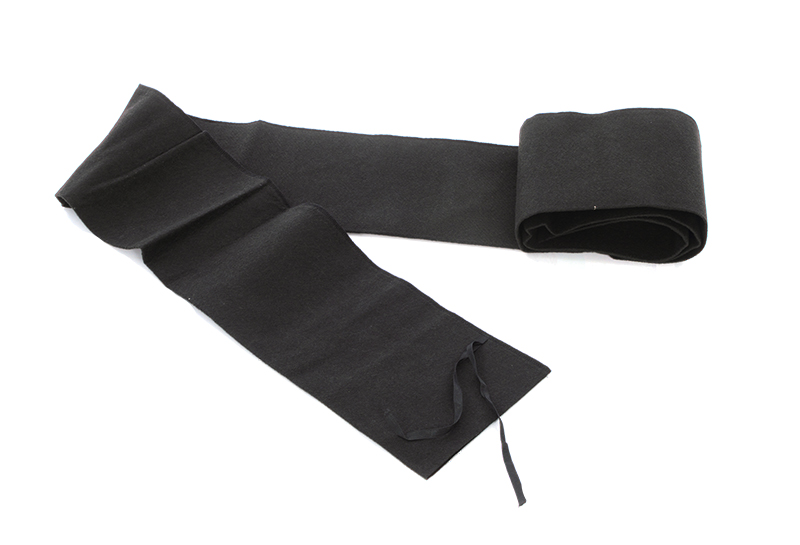
Geotextile Silt Socks
Price range: $5.50 through $154.00 (inc. GST)
-
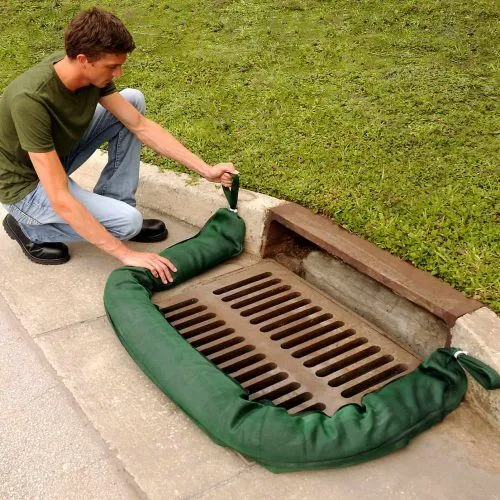
Ultra-Filter Sock
Price available upon request
-
Ultra-Gravel Bag
$2,178.00 (inc. GST)
Extra Information
Silt Socks
Effective Silt Socks for Australian Worksites
Silt socks are tubular geotextile sleeves filled with aggregate or filter media, laid on the ground to intercept sediment laden runoff and filter it before it reaches a pit, a kerb or a waterway. They sit on the surface under their own weight, so they work on concrete, asphalt and hardstand where a silt fence cannot be staked.
Akuna Services stocks silt socks for perimeter and inlet protection on civil, industrial, mining, utilities and local government sites. The range covers geotextile silt socks in multiple variants, the Ultra-Filter Sock and the Ultra-Gravel Bag.
11 am
Australia wide delivery, same day dispatch on orders before 11 am
100%
100 per cent Australian owned and operated since 2016
No stakes
Sits on concrete, asphalt and hardstand
300 mm
Minimum overlap at every joint
On this page
- 01What a Silt Sock Does and Where It Beats a Silt Fence
- 02Our Range of Geotextile and Aggregate Filled Silt Socks
- 03Silt Sock Sizes, Lengths and Flow Rates
- 04Pre-Filled and Unfilled Silt Sock Options
- 05Placing Silt Socks Around Pits, Kerbs and Stockpiles
- 06Silt Socks for Hard Surfaces Where Stakes Cannot Go
- 07Filtering Runoff Without Blocking the Flow
- 08Hydrocarbon Absorbing Socks That Do Two Jobs at Once
- 09Meeting Council and Sediment Control Plan Requirements
- 10Installation, Overlap and Replacement Intervals
- 11FAQs
What a Silt Sock Does and Where It Beats a Silt Fence
A silt sock slows runoff and filters it. Water ponds briefly on the upstream face, coarse particles drop out, and the rest passes through the sleeve at reduced velocity. A silt fence does the same job, but must be trenched and staked, which rules it out on anything sealed.
The sock wins wherever the ground will not take a stake:
| Situation | Silt fence | Silt sock |
|---|---|---|
| Sealed hardstand or car park | Cannot be trenched | Sits on the surface |
| Around an existing pit | Difficult to seal | Laid in a closed ring |
Our Range of Geotextile and Aggregate Filled Silt Socks
Geotextile Silt Socks. The core product, supplied in multiple variants so length and configuration suit the run. The sleeve holds the fill in place, resists UV and abrasion, and lets filtered water pass while sediment is retained on the upstream face.
Ultra-Filter Sock. An Ultratech product available on request, for inlet and perimeter duty where a manufactured, consistently filled sock is preferred to site filling.
Ultra-Gravel Bag. A gravel filled bag rather than a continuous sleeve, for modular units that stack or sit individually around a grate. Bags suit tight geometry and kerb inlets better than a long sock run, and sit alongside silt curtains for in-water works and dewatering bags for pumped discharge.
Silt Sock Sizes, Lengths and Flow Rates
Two dimensions decide performance. Height governs how much head the sock holds before water goes over the top, length how far the control runs. A taller sock traps more sediment but drains slower and needs a firmer surface underneath.
Flow through a sock is a function of the sleeve and the fill together. Coarse, clean aggregate passes water quickly and traps less fine material; a finer fill or tighter sleeve filters more but clogs sooner. Match the fill to the sediment you are seeing: clay runoff needs finer media than sandy spoil, and size the run to the catchment rather than the fence line.
Pre-Filled and Unfilled Silt Sock Options
Pre-filled socks arrive ready to place. The crew lifts them into position and the control is live in minutes, with no loose aggregate on site and no filling labour. They suit short mobilisations, emergency works and sites with no room for fill.
Unfilled sleeves ship light and are filled on site from your own aggregate. Freight drops sharply because you are not moving the fill, and you can vary the media along a run: coarser for drainage, finer for filtration. On a remote site freight decides it; on a tight city program, labour and space do.
Placing Silt Socks Around Pits, Kerbs and Stockpiles
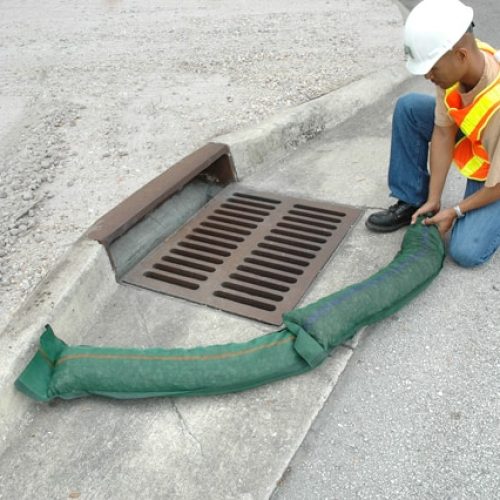
- Around a pit or grate. Lay the sock as a closed ring around the inlet with the ends overlapped, not butted, and leave the grate clear so the pit still takes design flow. For a sealed inlet, use a drain cover product instead.
- Along a kerb. Run the sock hard against the kerb face, upstream of the inlet, so water is filtered before reaching the opening. Kerb runs need a firm seal against the vertical face, where gravel bags often outperform a round sock.
- At a stockpile toe. Ring the stockpile on the downslope side, set back far enough that loaders do not run over it. These fill quickly in a wet season and need a shorter inspection cycle.
Silt Socks for Hard Surfaces Where Stakes Cannot Go
Sealed surfaces are the reason most sites buy socks. Concrete hardstand, asphalt car parks, bridge decks, wash bays, laydown yards and plant pads cannot be trenched, and drilling a stake into a slab is no option when the slab is the asset.
A sock holds position by mass and friction. On smooth concrete under high flow it can creep, so anchor long runs with gravel bags at intervals. On asphalt in summer heat, check it has not bedded into softened surface and formed a bypass channel. Socks are often specified with the stormwater management range.
Filtering Runoff Without Blocking the Flow
A sediment control that stops water entirely is a failed control. It backs up, finds the lowest point in the line and discharges everything it captured, usually during the storm that matters. A sock passes water at a reduced rate while retaining solids, keeping the site drained and the sediment collectable.
Two things cause blockage: sediment loading, where captured material seals the upstream face, and debris such as leaves and bark blinding the sleeve. Plan an overflow path too, so water that overtops reaches a second row or a sediment trap.
Hydrocarbon Absorbing Socks That Do Two Jobs at Once
On a wash bay, refuelling pad, plant yard or workshop apron, runoff carries both sediment and hydrocarbons, and a sediment sock alone leaves the oil sheen untreated. Akuna stocks absorbent socks in the absorbents range that take up oil and fuel while passing water, run in series with a silt sock.
The order is sediment first, hydrocarbon second. Put the silt sock upstream so it takes the solids load, then the absorbent downstream so it is not blinded and can work on the film. Reversing it shortens absorbent life sharply. Used hydrocarbon absorbents are regulated waste, so build disposal into the procedure covering your spill kits.
Meeting Council and Sediment Control Plan Requirements
Most councils and principal contractors require an erosion and sediment control plan before works start, and expect the controls on it to be on the ground and maintained. A sock on the drawing but sitting in the compound fails an inspection as surely as no control.
Keep the following on file:
- 1Product specification and placement on the plan
- 2Dated installation photographs showing overlap and position
- 3Inspection records, weekly minimum and after every rainfall event
- 4Replacement and disposal records, including hydrocarbon absorbents
General environmental duty provisions and the duty to control risk under the WHS Regulations 2011 sit behind this. If you are unsure your controls match the risk, our environmental risk assessment documents it properly.
Installation, Overlap and Replacement Intervals
Overlap matters more than length. Butted ends open under flow and become the failure point, so overlap each joint by at least 300 mm.
Worked example
- A 20 metre kerb run using 3 metre socks gives 3 metres for the first sock and 2.7 metres of new coverage for each one after.
- You need 8 socks, not the 7 you get by dividing 20 by 3.
Inspect weekly and after every rainfall event. Clean out or replace the sock once captured sediment reaches roughly one third to one half of its height, because beyond that it ponds rather than filters. Take the sediment to a stabilised area, not back onto the surface you are protecting.
At the end of works, recover the socks: intact sleeves can be emptied, washed and reused, and torn or UV degraded sleeves retired.
Send us your surface type, run lengths and catchment and we will specify it. Call 1300 912 949 or browse silt and sediment control.
FAQs
Can silt socks be used on concrete and asphalt?
Yes, and that is their main advantage over a silt fence. Socks hold position by weight and friction rather than stakes, so they suit sealed hardstand, car parks, bridge decks and plant pads. On smooth concrete, anchor long runs with gravel bags.
How much should I overlap silt socks?
Overlap each joint by at least 300 mm, never butt the ends. On a 20 metre run using 3 metre socks that means 8 socks, because only the first gives its full length and each one after adds 2.7 metres.
When should a silt sock be replaced?
Replace or clean out the sock once captured sediment reaches about one third to one half of its height, because past that it ponds rather than filters. Inspect weekly and after every rainfall event, and shorten that interval at a stockpile toe in the wet season.
Do silt socks handle oil as well as sediment?
A standard silt sock filters sediment only. Where runoff carries hydrocarbons, run an absorbent sock downstream so it is not blinded by solids. Used hydrocarbon absorbents are regulated waste and must be disposed of accordingly.
Want to book a spill training session?
Get in touch with our expert team and we will guide you through the process.