
Dewatering Bags
Showing all 2 results
-
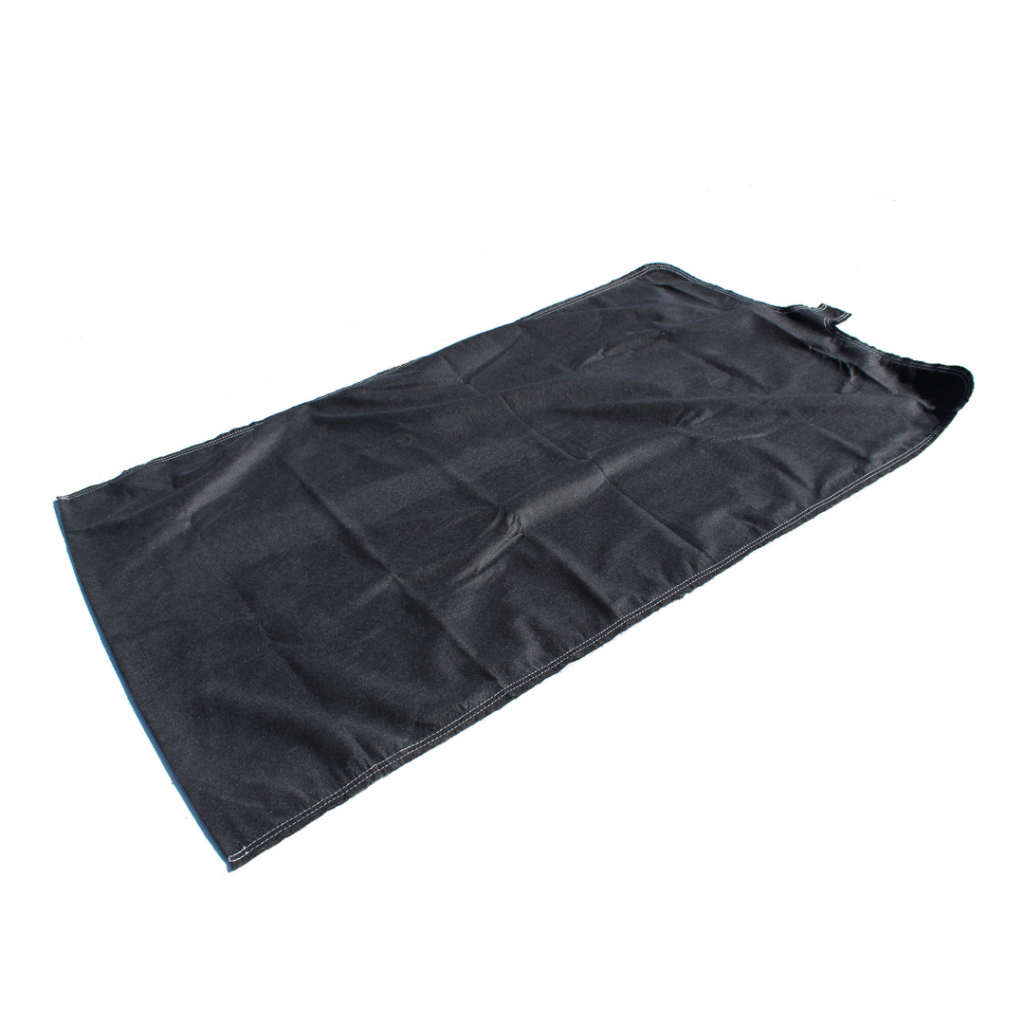
Chatoyer Dewatering Bag
Price range: $33.00 through $462.00 (inc. GST)
-
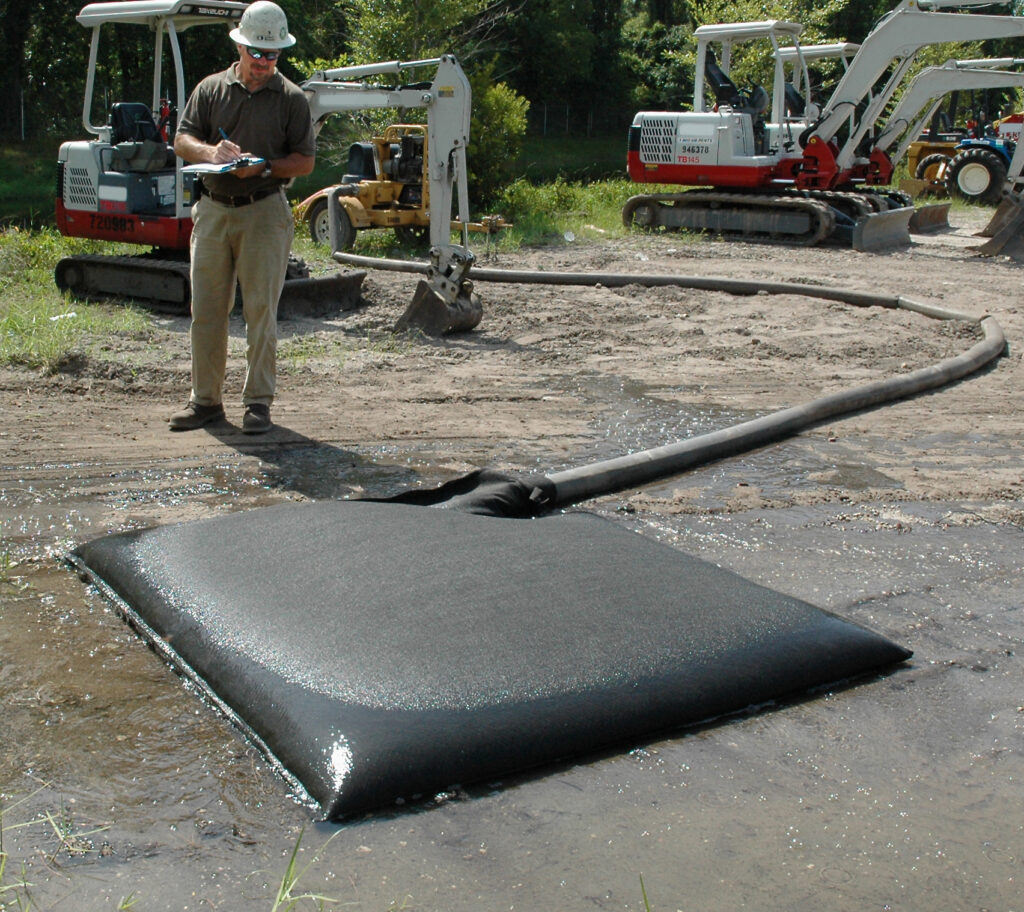
Ultra-Dewatering Bag Oil & Sediment Model
Price range: $137.50 through $649.00 (inc. GST)
Extra Information
Dewatering Bags
High-Performance Dewatering Bags for Australian Sites
Dewatering bags are geotextile filter bags that take the discharge from a pump and hold back the sediment, so what leaves the bag is clean, silt-free water. You connect the hose to the neck, run the pump, and the fines stay inside while filtered water seeps out.
Whether you are a construction company building major infrastructure or a local builder laying foundations for our communities, we all share the responsibility of keeping our waterways clean. That is why Akuna Services offers dewatering bags in 260 gsm geotextile with 90 micron filtration and polypropylene Camlocks.
260 gsm
Geotextile fabric
90 micron
Filtration
11 am
Australia wide delivery, same day dispatch before 11 am
100%
100 per cent Australian owned and operated
On this page
- 01What a Dewatering Bag Does During a Pump-Out
- 02Our Range of Dewatering Bag Sizes and Flow Rates
- 03260 GSM Geotextile and 90 Micron Filtration
- 04Camlock Fittings and Hose Connection Options
- 05Dewatering Bags for Excavations, Trenches and Cofferdams
- 06Positioning and Supporting a Filled Dewatering Bag
- 07Clean, Silt-Free Discharge Every Time
- 08Double Stitched Necks Built to Hold Pressure
- 09Meeting Sediment Control Obligations on Site
- 10Choosing a Dewatering Bag for Your Sediment Load
- 11FAQs
What a Dewatering Bag Does During a Pump-Out
Pumping out an excavation moves water and sediment together. Discharge that straight to a drain or a watercourse and you have put your site’s spoil into the stormwater system, the most common sediment offence on a construction site.
The bag sits between the pump and the discharge point. Water enters through the neck, spreads out, and passes through the geotextile at a controlled rate. Heavy particles drop out immediately, fines are held at the fabric face, and the water leaving is clear enough to discharge. The bag is also a settlement vessel: water slows as it spreads, so particles finer than the pore size settle inside.
Our Range of Dewatering Bag Sizes and Flow Rates
| Product | Filters | Best suited to |
|---|---|---|
| Chatoyer Dewatering Bag | Sediment and silt | Excavation, trench and pit dewatering |
| Ultra-Dewatering Bag, Oil and Sediment Model | Sediment plus hydrocarbons | Plant yards, wash bays, fuel areas |
Both come in multiple variants so the size suits your pump and volume. Bigger is generally better: more filtering surface, longer before it blinds, more sediment held.
The neck size of 100 mm on the width enables 80 L/m2/sec filtration.
Worked example
- Worked through, a bag presenting two square metres of filtering face has far more capacity than a 100 mm pump delivering around 1,500 litres a minute, or 25 litres a second.
- The real limit is not rated flow but how fast the fabric blinds with fines, so size up rather than down.
If you need a higher flow rate, our professionals can help you choose.
260 GSM Geotextile and 90 Micron Filtration
Our sediment control and filtration bags are fabricated from top quality 260 gsm geotextile fabric. That weight makes them robust enough for the harsh Australian climate and demanding job site conditions. Whether you face heavy rainfall or scorching sun, the bags hold their integrity and perform consistently.
The 90 micron pore size is the other half of the equation. It lets liquids flow freely while retaining sediment rather than letting it lodge in the fabric, which keeps filtration seamless and the bag long lasting. Sand and coarse silt are retained outright, and finer material settles inside. Geotextiles in sediment control are commonly tested to the AS 3706 series, and gsm and pore size are the numbers worth comparing.
Camlock Fittings and Hose Connection Options
We provide 50 and 100 mm Camlocks, enabling rapid connection and disconnection of hoses without specialised tools. With these you can deploy a bag and have it running in minutes wherever the site needs it.
The Camlocks are polypropylene, which makes them lightweight and easy to handle. They are chemical resistant, so you can filter a range of fluids without damaging the fitting. Match the Camlock to your hose: 50 mm for smaller submersible and trash pumps, 100 mm for a larger diesel pump at full flow. Support the hose so its weight does not hang on the neck, and keep the Camlock lubricated.
Dewatering Bags for Excavations, Trenches and Cofferdams
- Excavations and pits. Groundwater and rainwater collect in any open excavation and always carry fines. A bag on the discharge line lets you keep pumping and stay compliant without trucking water off site.
- Trenches and service works. Utilities, water authorities and civil contractors use bags where trench discharge goes to a kerb, grassed area or stormwater pit, often paired with silt socks at the receiving inlet.
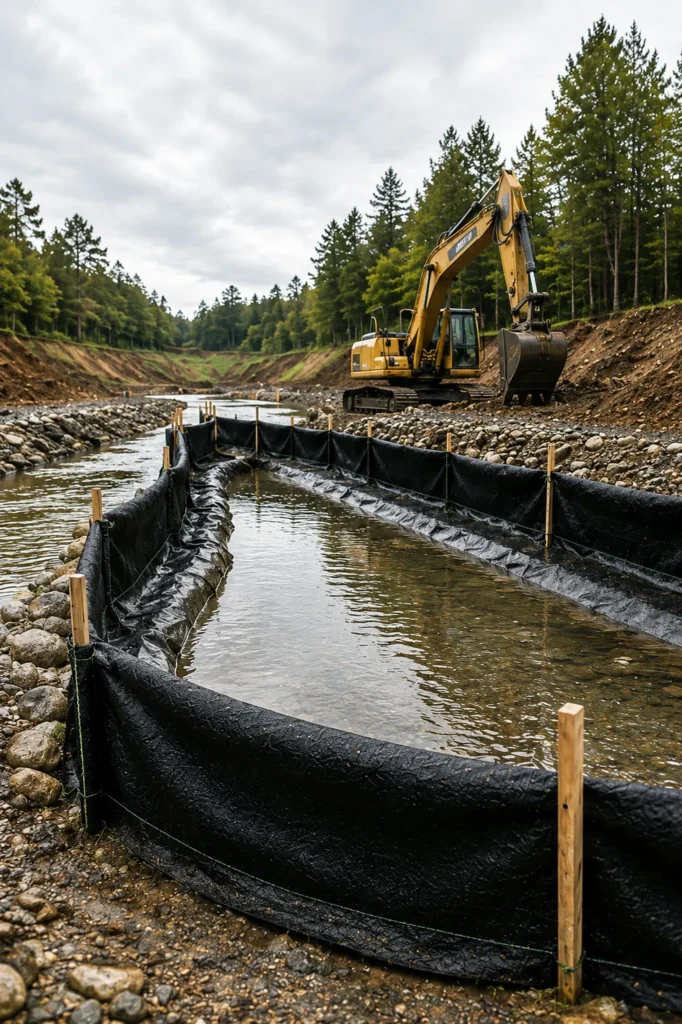
- Cofferdams and in-water works. Water pumped from inside a cofferdam is usually the dirtiest on the job. Bags handle the pump-out while a silt curtain barrier manages turbidity outside. Mining, defence, transport and local government sites use the same arrangement.
Positioning and Supporting a Filled Dewatering Bag
Put the bag where the filtered water can do no harm. A grassed or vegetated area is ideal because it treats the discharge a second time, and a gravel bed keeps the underside off wet ground while helping water get away.
Ground slope matters. Set the bag on a gentle fall so filtered water drains away rather than pooling underneath, and keep it clear of the excavation so water cannot return. Position it before you start, because a full bag is heavy and cannot be moved, and keep it off traffic routes where a tyre could tear the fabric.
Clean, Silt-Free Discharge Every Time
Our dewatering bags are specifically engineered to filter heavy particles out of water so that silt-free water is released. This prevents the pollution and sedimentation problems that affect local ecosystems and waterways, and it keeps you pumping on schedule.
Watch the discharge, not the clock. Clear water seeping evenly across the surface means the bag is working. Water escaping as a jet, ponding on top, or running cloudy means the bag is blinded, overfilled or damaged, and it is time to change it.
Where the water carries oil as well as sediment, use the Ultra-Dewatering Bag oil and sediment model, or run absorbent products downstream.
Double Stitched Necks Built to Hold Pressure
Our dewatering bags for Australian businesses are designed with a double stitching methodology that provides additional thickness at the neck. The neck is where pump pressure concentrates, so it is where an ordinary seam gives way first. Doubling the stitching puts strength exactly where the load is.
Combined with our Camlocks, the double stitched neck lets the bags endure high pressure, temperature fluctuations and corrosive substances. That matters where a pump runs unattended for hours, and it matters for reuse: a neck that holds its shape connects again next job.
Meeting Sediment Control Obligations on Site
Sediment control is a crucial part of environmental compliance on Australian worksites. Councils, principal contractors and asset owners expect an erosion and sediment control plan before works start, and the dewatering method on it to be the one actually in use.
For your paper trail, keep:
- 1Product specification, including gsm and pore size
- 2Dated photographs of the bag in position, discharge running
- 3Inspection records covering each pump-out
- 4Disposal records for captured sediment and used bags
General environmental duty provisions and the duty to control risk under the WHS Regulations 2011 sit behind this. Our products help businesses comply with local and national regulations covering water quality, sediment control and spill prevention, and our environmental risk assessment puts the risk in writing.
Choosing a Dewatering Bag for Your Sediment Load
Start with the water, not the pump. Clean groundwater with a light silt load runs through a bag for a long time. Clay rich water, bored pile slurry or plant yard washdown blinds a bag quickly, so plan on more bags or a larger size.
Then match the fitting and the volume. Use a 50 mm Camlock with smaller pumps and 100 mm with larger ones, and choose the bag against the total volume you expect to move, not flow rate alone. Stop using a bag once it is around half full of sediment, because filtration falls away quickly past that point.
We offer a range of environmental compliance products besides dewatering bags, and our experts can analyse your site and recommend the right solution. Call 1300 912 949 or browse the silt and sediment control range.
FAQs
How do I know when a dewatering bag is full?
Stop using it once it is roughly half full of sediment, or when filtered water stops seeping evenly across the surface. Water ponding on top, escaping as a jet or running cloudy means the fabric has blinded.
Can a dewatering bag remove oil as well as sediment?
A standard bag filters sediment. For water carrying hydrocarbons, use the Ultra-Dewatering Bag oil and sediment model, or run absorbents downstream of a standard bag. Used hydrocarbon absorbents are regulated waste and must be disposed of accordingly.
How do you make the dewatering bags last?
With regular inspections and proper care you can significantly extend their life. Keep an eye on them, clean out built-up sediment, rinse the fabric before it dries hard, and lubricate the Camlocks.
Can you provide installation and maintenance support?
Yes. We offer support including installation guidance and ongoing maintenance. Onsite services are based in New South Wales, with limited coverage into Queensland and Victoria through contractors and partners, while products ship Australia wide.
Want to book a spill training session?
Get in touch with our expert team and we will guide you through the process.