
Resource Hub
AS1940 bunding capacity: how to size a bund
Categories
Share
Quick answer
AS 1940:2017 requires a spill compound for packaged flammable and combustible liquids to hold at least 100 per cent of the largest single package, plus a share of the aggregate storage volume. That share is widely applied as 25 per cent of the first 10,000 litres, 10 per cent of the volume between 10,000 and 100,000 litres, and 5 per cent above that. Bulk tanks are sized differently. The widely applied figure is 110 per cent of the largest tank, with interconnected tanks treated as one and displaced volume deducted, and it is worth knowing that this figure comes from state EPA guidance such as the EPA Tasmania bunding guidelines rather than from AS 1940 itself, despite being routinely attributed to it.
The AS1940 bunding requirements therefore change with the configuration, and applying the tank figure to a drum or IBC store is the most common way a site fails an audit, because it yields roughly half the volume the package store calculation asks for.
What AS1940 covers and who it applies to
AS 1940:2017 The storage and handling of flammable and combustible liquids is the current edition, carrying Amendment 1:2019 and Amendment 2:2021, so a file citing the superseded AS 1940-2004 is out of date. The WHS Regulations 2011 call it up in the harmonised jurisdictions, which turns it from guidance into a duty.
It covers Class 3 flammable liquids and combustible liquids in packages, IBCs and tanks. A mixed store often satisfies more than one standard: AS 3780 for corrosives, AS/NZS 4452:1997 for toxics, AS 4326-1995 for oxidising agents, AS 2507-1984 for agvet chemicals. Incompatible classes must not share a compound.
Where bunding sits inside AS1940
Containment is treated as a system: hold the design spill, keep it out of stormwater and soil, keep it clear of ignition sources, stay accessible for response. Capacity alone never closes a finding, because an assessor also wants freeboard, drainage, material compatibility and the inspection record.
How to calculate required bund capacity
Work in litres, then convert, since 1,000 L equals 1 m3.
Package stores (drums, jerry cans, IBCs, portable tanks), the widely applied AS 1940 formula:
- 100 per cent of the largest single package, plus
- 25 per cent of aggregate capacity up to 10,000 L, plus
- 10 per cent of the portion between 10,000 L and 100,000 L, plus
- 5 per cent of the portion above 100,000 L.
Bulk tanks: at least 110 per cent of the largest tank, interconnected tanks treated as one. Both cases add 20 minutes of discharge where a fire suppression system serves the compound.
One caution. Some summaries present the largest package and the aggregate percentage as an either or test, others as additive. The additive reading is conservative and is used below, but confirm it against the current edition rather than a summary. Regulators can also ask for more, and where a licence condition names a figure, that figure governs.
Worked example: drums and IBCs on a bunded pallet
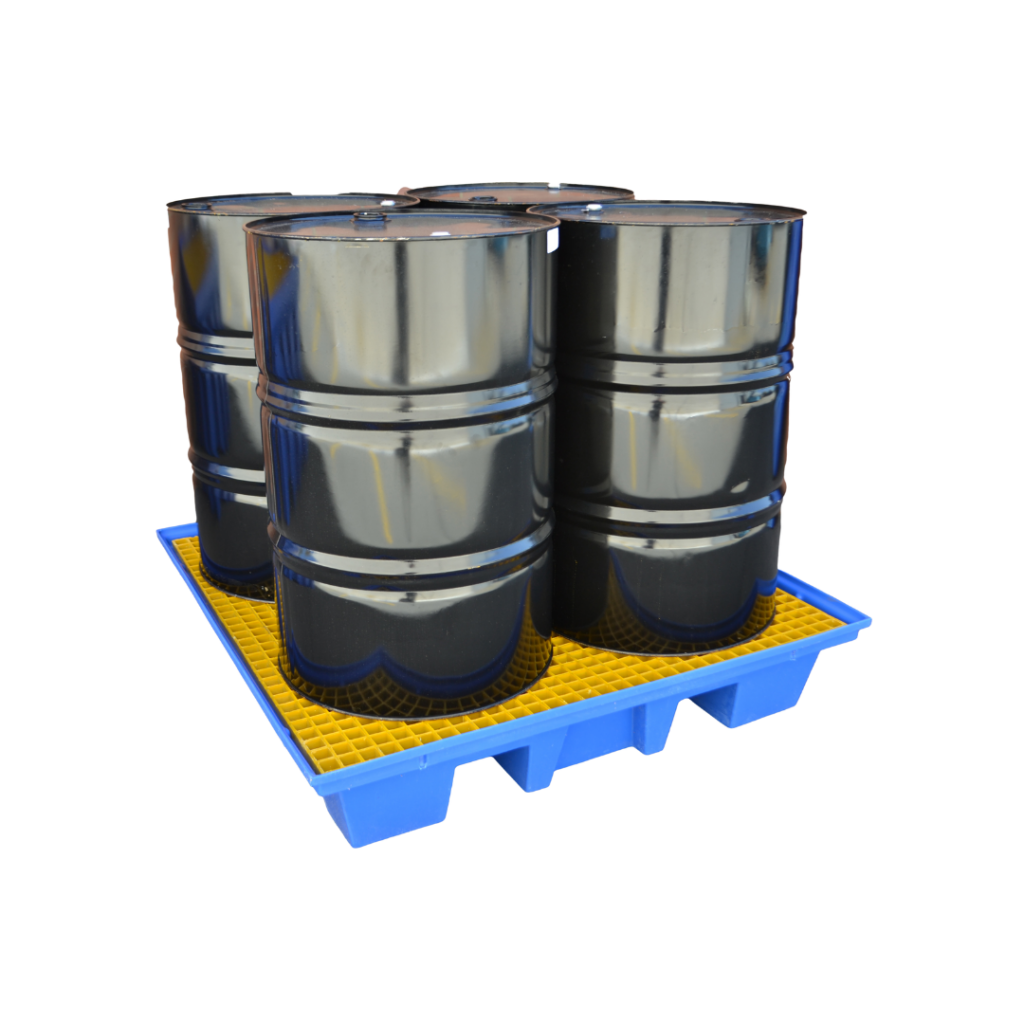
Four 205 L drums of diesel:
Worked example
- Largest package 205 L, aggregate 820 L
- 205 + (25 per cent of 820 = 205) = 410 L required
A typical four drum spill pallet has a nominal sump near 250 L, meeting the largest package leg alone and falling 160 L short of the combined figure.
Two 1,000 L IBCs:
Worked example
- Largest package 1,000 L, aggregate 2,000 L
- 1,000 + (25 per cent of 2,000 = 500) = 1,500 L required
A 1,100 L sump meets 110 per cent of the largest IBC, which is why it feels right, and is 400 L short.
Worked example: a bunded storage area
| Item | Qty | Unit | Subtotal |
|---|---|---|---|
| Waste oil drums | 12 | 205 L | 2,460 L |
| Solvent IBCs | 6 | 1,000 L | 6,000 L |
| Degreaser drums | 40 | 20 L | 800 L |
| Aggregate | 9,260 L |
Largest package is 1,000 L and aggregate sits below the 10,000 L threshold, so: 1,000 + (25 per cent of 9,260 = 2,315) = 3,315 L, or 3.315 m3.
The floor is 6 m x 4 m, giving 24 m2. Dividing 3.315 by 24 gives 0.138 m, so a 150 mm kerb looks adequate at 3.6 m3 gross. It is not. Pallets and plinths occupy about 8 m2 to a height of 150 mm, removing 8 x 0.15 = 1.2 m3 and leaving 2.4 m3 net.
At a 250 mm kerb the gross becomes 6.0 m3, displacement stays at 1.2 m3, and net capacity is 4.8 m3. Grow the store to 60,000 L aggregate and the tiers apply: 1,000 + 2,500 + (10 per cent of the 50,000 L in the upper band = 5,000) = 8,500 L.
The 110 per cent rule and how displacement changes the number
The 110 per cent figure belongs to tanks, and it is a net requirement. Everything inside the compound below the top of the wall reduces what it can hold.
A compound 10 m x 5 m with a 500 mm wall:
Worked example
- Gross 25 m3; largest tank 20,000 L, so required 22 m3
- Displacement below 500 mm: second tank and base 3.2 m3, largest tank plinth 1.4 m3, pipe supports 0.4 m3 = 5.0 m3
- Net 20 m3, which fails by 2 m3
Raise the wall to 600 mm: gross 30 m3, displacement about 6.0 m3, net 24 m3, which passes. Practice normally deducts everything except the failed tank itself, since its contents are what you are catching. State that convention on the calculation sheet.
Bund construction, materials and compatibility
- Impervious to the liquid stored, not just to water. Concrete is porous to many solvents, so use a compatible coating or liner.
- No penetrations below the top of the wall. Every pipe crossing below that line is a leak path.
- Falls to a collection sump, and vehicle rated where forklifts enter. A cracked kerb has stopped being a bund.
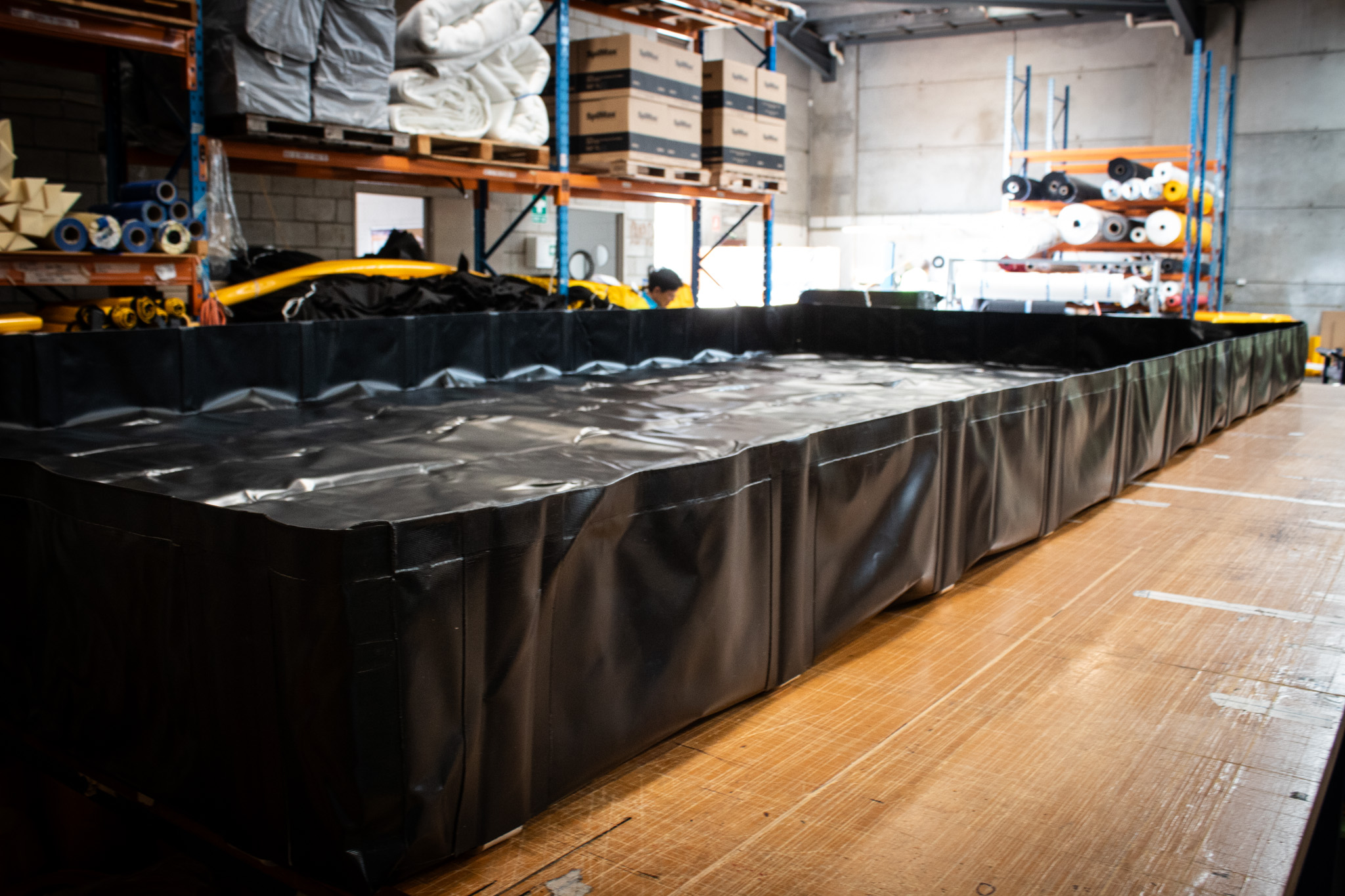
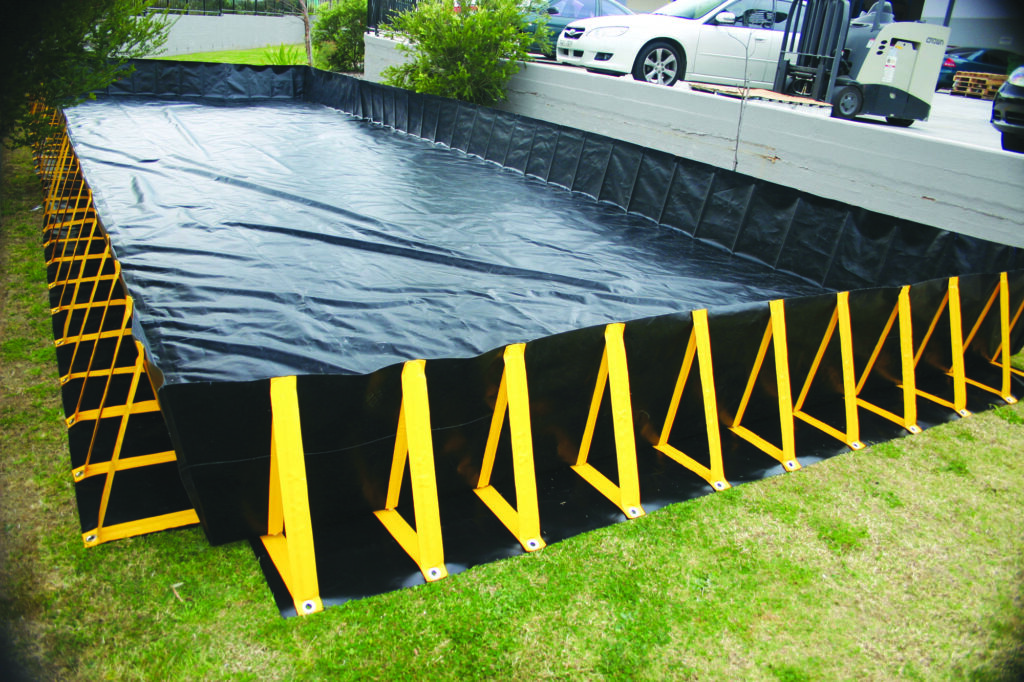
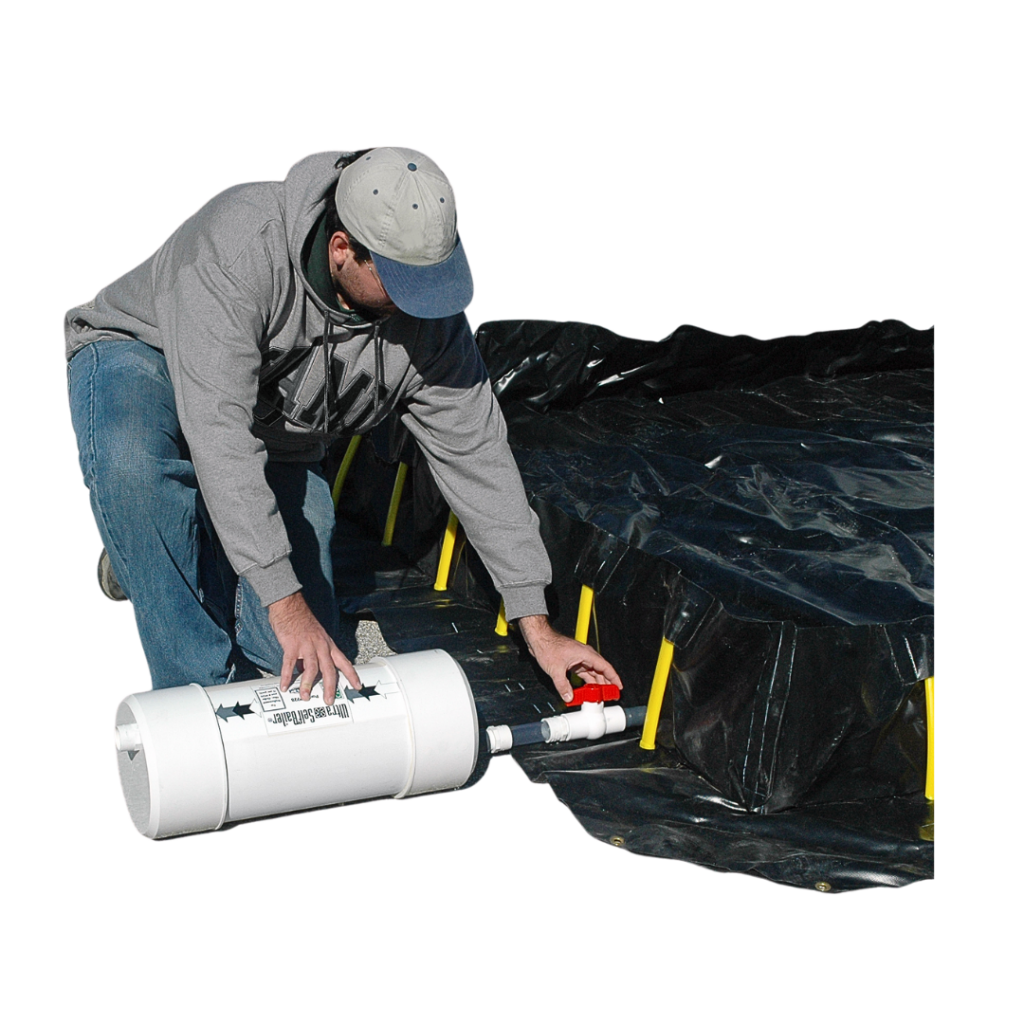
- Portable containment for temporary works: collapsible bunds, spill berms, spill decks and bunded pallets Spill Containment on Land.
Polyethylene suits most fuels, oils and many acids. Some solvents and strong oxidisers need a different liner.
Drainage, rainwater and keeping the bund empty
- Roof or cover outdoor package stores. It is the cheapest capacity you will buy.
- Treat accumulated water as potentially contaminated until checked.
- No open gravity drain valve. Use a normally closed, locked valve or manual pump out.
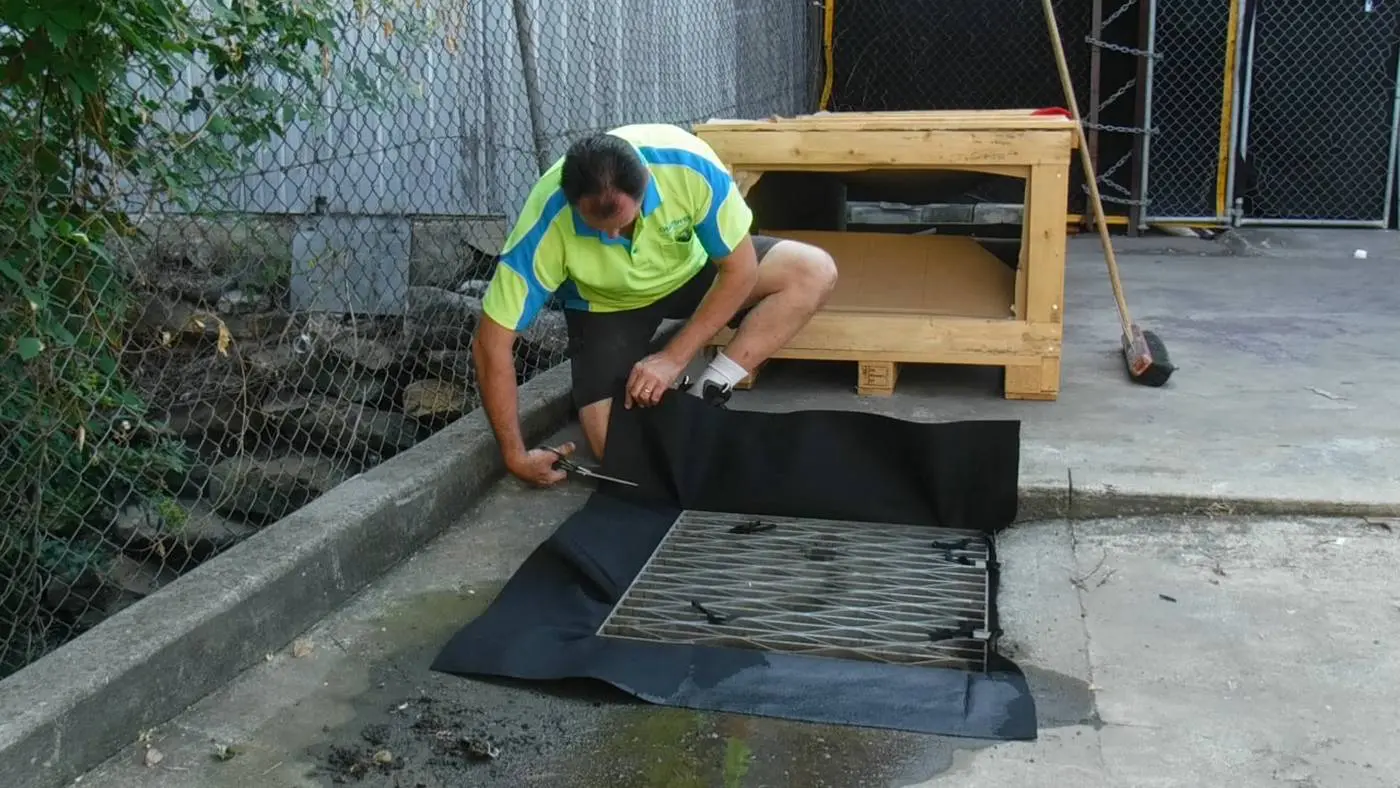
- Log every pump out, and protect surrounding drains with covers, seals or pipe socks Stormwater Management.
Freeboard matters as well as volume, because a ruptured container drops its contents in one surge.
Separation distances and siting
AS 1940:2017 sets separation distances to protected places, boundaries, ignition sources and other dangerous goods classes, varying with quantity, flash point class and whether the store is indoors, outdoors or roofed. Take the figures from the current edition for your own quantity and class, not from a generic table.
Inspection and maintenance obligations
| Frequency | Check |
|---|---|
| Weekly | Bund empty, sump clear, absorbents present |
| Monthly | Kerb, liner, joints, valve closed and locked |
| Quarterly | Calculation still matches actual stock |
| Annually | Condition assessment, calculation re-signed |
The quarterly reconciliation catches the most findings, because stock creeps and a compliant compound quietly stops being compliant.
Where sites most often fall short of the standard
- Applying 110 per cent to a package store, which typically yields half the required volume
- Using gross capacity instead of net
- Sizing on average stock rather than maximum holding
- Rainwater in an open outdoor bund, with no pump out procedure or record
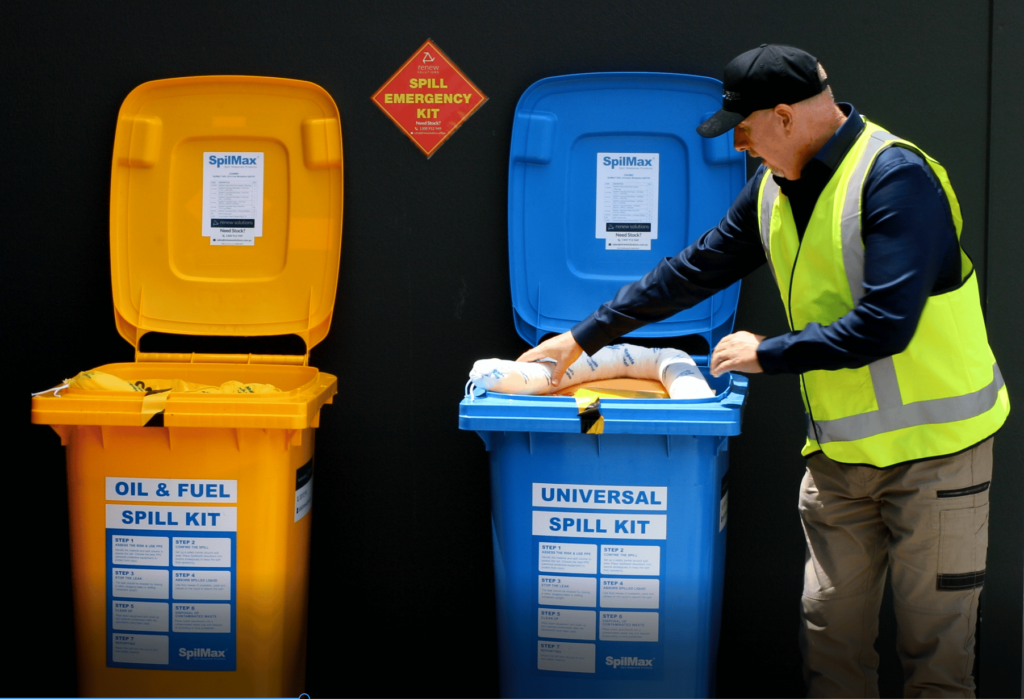
- No calculation sheet, so there is nothing to hand an auditor Spill Kits
Sizing your bunding with an environmental risk assessment
The arithmetic is straightforward. Establishing which containers, quantities and classes feed into it takes a site walk, and that is what an auditor interrogates.
Akuna Services runs an environmental risk assessment that records what is stored and where, works the calculation per location and identifies gaps against the applicable standards. Akuna has supplied Australian sites since 2016, is 100 per cent Australian owned and operated and services sites nationwide from Pendle Hill in NSW.
AS1940 bunding requirements: frequently asked questions
Does AS 1940 require 110 per cent or 25 per cent for bunding?
Both, depending on configuration. Bulk tanks use 110 per cent of the largest tank. Package stores use 100 per cent of the largest package plus a tiered percentage of aggregate storage, from 25 per cent of the first 10,000 litres.
Which edition of AS 1940 is current?
AS 1940:2017, with Amendment 1:2019 and Amendment 2:2021. It superseded AS 1940-2004, which many guides still quote.
Do I subtract the volume of tanks and pallets inside the bund?
Yes. Capacity is a net figure, so deduct other tanks, plinths, foundations and pallets below the top of the wall.
Is a bunded pallet enough for four 205 litre drums?
Often not. Four drums require 410 L under the additive calculation and a typical four drum sump is near 250 L, so use a higher capacity unit or a bunded floor area.
Akuna Services supplies bunded pallets, spill decks, collapsible bunds, floor bunding, containment walls, berms and trays, with same day dispatch on orders placed before 11 am. To have the numbers worked and documented before an audit, book an environmental risk assessment or call 1300 912 949.