
Resource Hub
Do I Need Bunding? Australian Requirements Explained
Categories
Share
Quick answer
Bunding is required on any Australian site where stored liquids could reach soil, a drain or a waterway, or where those liquids carry a dangerous goods class. A bund is a liquid tight barrier that holds a leak inside a defined area long enough for you to recover it. For most Australian industrial, civil, mining, transport, utilities, defence and government sites holding fuel, oil, coolant, acids, alkalis or agricultural chemicals in drums, IBCs or tanks, the real question is not whether bunding is required but how much capacity you must prove, in what form, and against which standard.
So what is bunding in the way an auditor reads it? Not a product category. A calculated volume, tied to the largest single container you hold and the aggregate volume in the area, that you can evidence on paper.
What bunding is and what it actually does
Bunding is secondary containment. The primary container is the drum, IBC or tank; the bund is the second line, sized so that when the primary container fails, the liquid stays put. A compliant bund contains the released volume without overtopping, resists the substance it holds, isolates the area from stormwater, and allows recovery of what it catches. A bund that fills with rainwater and is then drained to stormwater has contained nothing.
Which liquids on your site require bunding
Work from two lists, not one.
- Dangerous goods. Anything with a class and packing group in the safety data sheet: Class 3 flammable and combustible liquids, Class 8 corrosives, Class 5.1 oxidising agents, Class 6.1 toxic substances.
- Environmentally harmful liquids that are not dangerous goods. Used oil, coolant, hydraulic fluid, AdBlue, detergents, concrete slurry, leachate. No DG class, but a discharge still exposes you under state environment law.
In New South Wales the Protection of the Environment Operations Act 1997 prohibits polluting waters at section 120, whether or not the liquid is a dangerous good. Every state and territory has an equivalent offence.
The 110 per cent rule explained in plain terms
The 110 per cent rule says a bund holding a single tank must take 110 per cent of that tank’s volume, giving you the full contents plus a margin for rain and wave action.
Worked example
- One 1,000 litre IBC of hydraulic oil
- 1,000 L x 1.10 = 1,100 L of usable capacity
Interconnected vessels count as one unit. Where several unconnected vessels share a bund, the second test is 25 per cent of the total volume held, and you take the larger number:
Worked example
- Twelve 205 litre drums = 2,460 L aggregate
- 25 per cent of 2,460 L = 615 L
- 110 per cent of the largest container = 205 x 1.10 = 225.5 L
- Required capacity = 615 L
The percentage is not identical everywhere. Tasmania’s bunding and spill management guidance uses 110 per cent of the largest vessel or 25 per cent of the total, whichever is greater. South Australia’s EPA bunding guidance asks for at least 120 per cent of the net capacity of the largest tank, and at least 133 per cent where flammable liquids are stored. Check your own regulator before you sign off a design.
How bund capacity is calculated, and where displacement catches people out
For packaged storage of flammable and combustible liquids, AS 1940-2017 sets a compound capacity built in layers rather than a flat percentage: 100 per cent of the largest package, plus 25 per cent of storage capacity up to 10,000 litres, plus 10 per cent of capacity between 10,000 and 100,000 litres, plus 5 per cent above that.
Worked example
- Twenty 205 litre drums = 4,100 L storage capacity
- 100 per cent of the largest package = 205 L
- 25 per cent of 4,100 L = 1,025 L
- Required compound capacity = 1,230 L
Now the part that fails audits. Anything standing inside the bund displaces capacity. Drums, tank feet, plinths and pump skids all take up volume you cannot count.
Worked example
- Containment area 5 m x 4 m with a 150 mm wall = 20 m2 x 0.15 m = 3,000 L gross
- Ten 205 litre drums on the floor, each about 585 mm in diameter, occupy roughly 0.27 m2 each
- 10 x 0.27 m2 x 0.15 m = about 403 L displaced
- Usable capacity = 2,597 L, not 3,000 L
Rainfall is the second deduction. An open bund on a wet season site is holding water, not spare capacity. State guidance favours a roof with an overhang past vertical; where that is impractical, the bund needs a normally closed outlet and a documented inspection routine.
Bunded pallets and spill trays
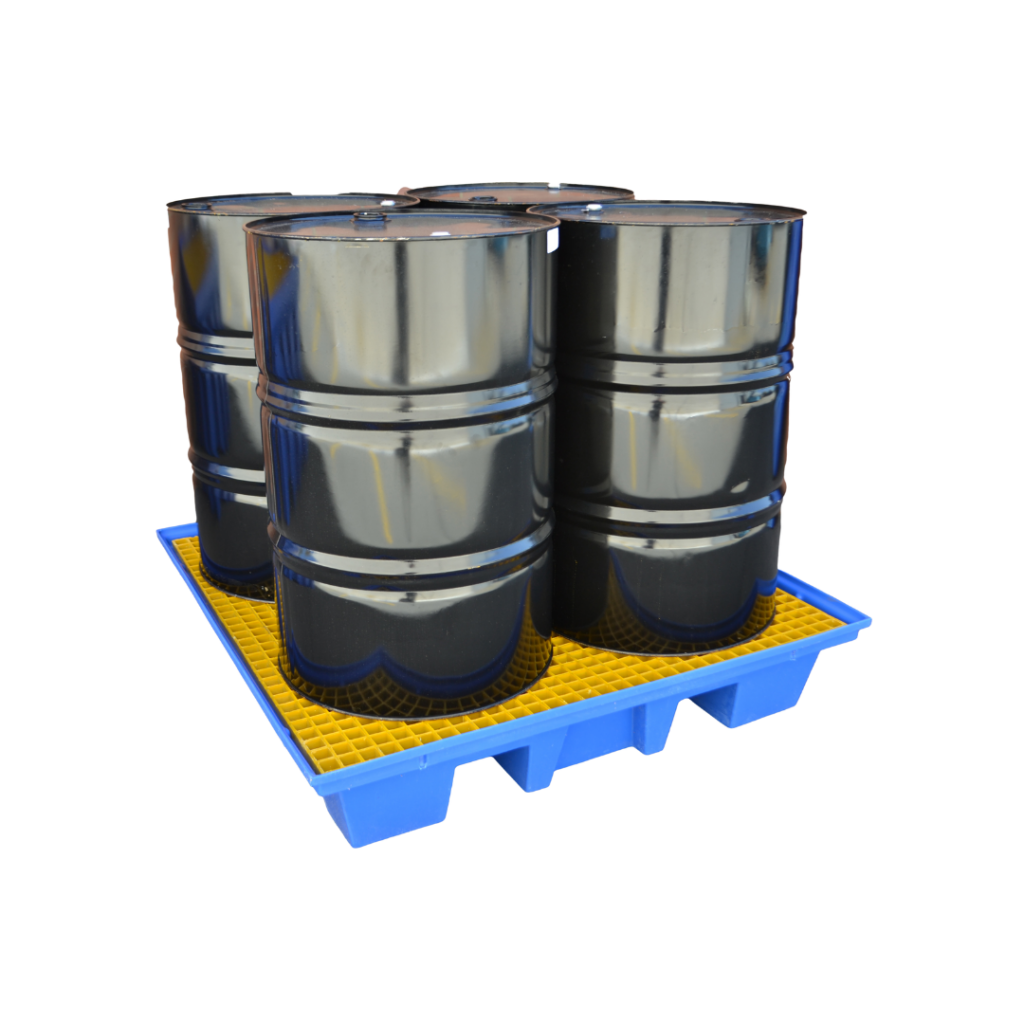
Bunded pallets are the workhorse for drum and IBC storage. Four drum, two drum and single IBC units each carry a stated sump capacity, and that figure is your evidence. Because drums sit on a grate above the sump, displacement is not an issue. Spill trays and decks suit smaller decanting points, benches, generator sets and pump stations where the volume at risk is tens of litres.
Floor bunding, flexible and rubber
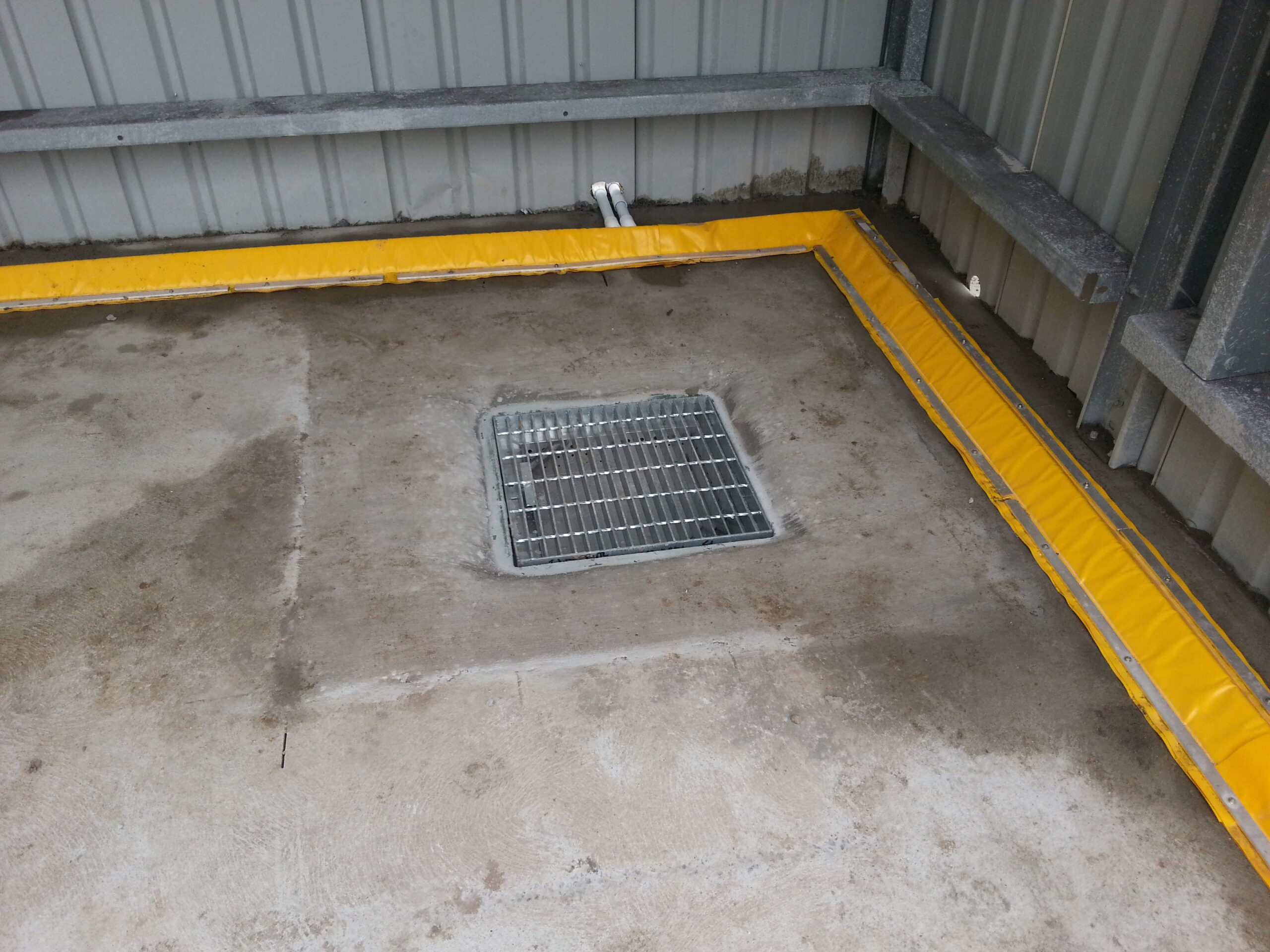
Flexible floor bunding is a low profile polyurethane or rubber barrier bonded to a concrete floor, used to define a containment zone or keep liquid away from a roller door or drain. The profile is driveable, so forklifts can cross it. Height is modest, so calculate carefully: 6 m x 3 m at 75 mm gives 1,350 L.
Collapsible and portable bunding
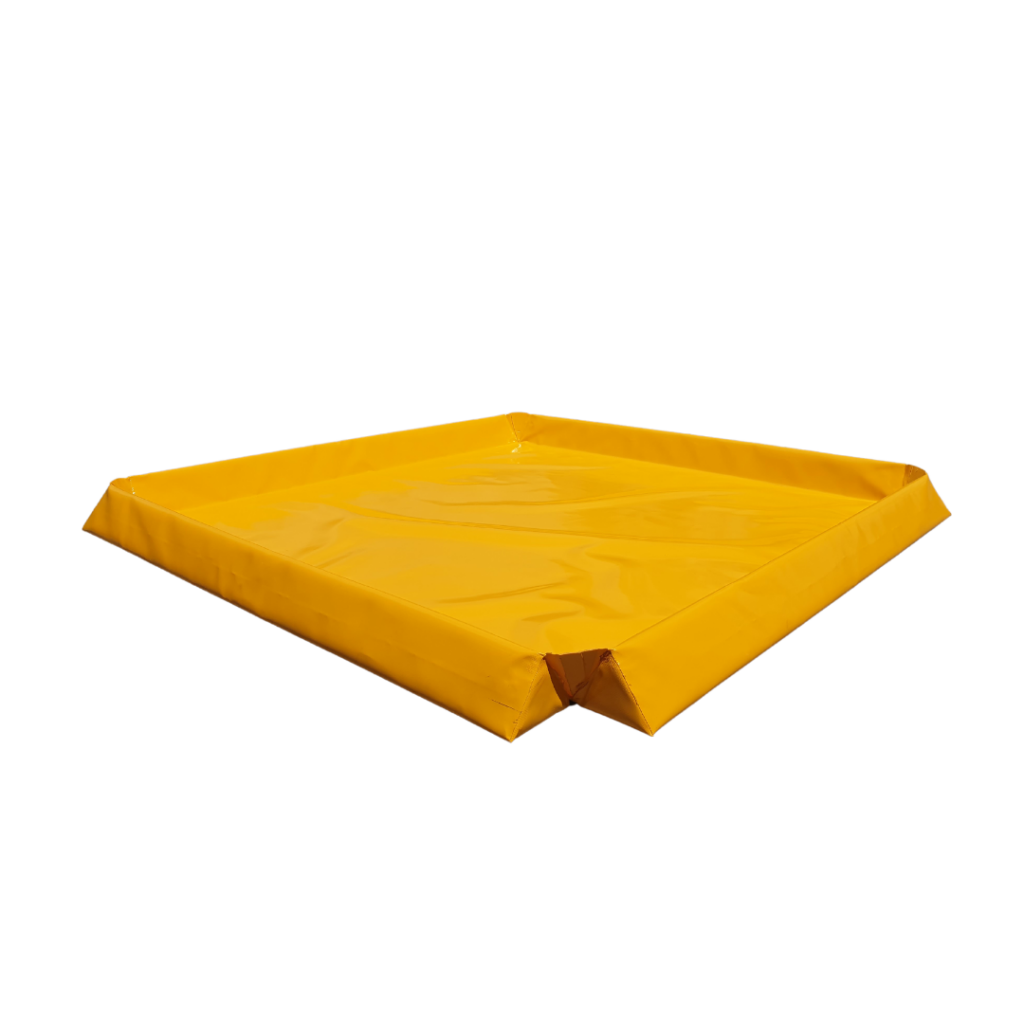
Collapsible bunds have foam or spring loaded walls that fold flat for transport, which suits maintenance work, mobile plant refuelling and temporary laydown areas. Size them the same way: 2.4 m x 1.2 m with 150 mm walls gives 2.88 m2 x 0.15 m = 432 L, before subtracting whatever you park in it.
Containment walls and permanent bunded areas
Where volumes are large or permanent, the answer is a constructed containment area: sealed floor, bund walls, no uncontrolled drainage, and a material that resists the stored substance. Modular containment walls and berms achieve the same outcome without civil works where a slab exists. Earthen bunds are generally discouraged in state guidance, because permeability cannot be shown.
Choosing bunding by dangerous goods class
| Class | Typical liquids | Standard | Capacity approach |
|---|---|---|---|
| Class 3 flammable and combustible | Petrol, diesel, solvents | AS 1940-2017 | Layered compound capacity, non combustible bund, controlled drainage |
| Class 8 corrosives | Sulfuric acid, caustic soda | AS 3780 (current edition AS 3780:2023) | Greater of 25 per cent of aggregate or the largest container, with a package storage cap |
| Class 5.1 oxidising agents | Hydrogen peroxide, sodium hypochlorite | AS 4326-2008 | Packing Group I liquids 100 per cent of aggregate, PG II and III 25 per cent, never less than the largest container |
| Class 6.1 toxic substances | Pesticide concentrates, biocides | AS/NZS 4452:1997 | Same packing group split as AS 4326 |
| Agvet chemicals | Herbicides, dips, drenches | AS 2507-1998 | Contained, separated store |
Check the safety data sheet against the bund material before buying: polyethylene is fine under diesel and unsuitable under some oxidisers.
Australian standards and state EPA obligations
Three layers apply at once.
- WHS Regulations 2011. Regulation 357, containing and managing spills, requires a spill containment system that allows the effective clean up and disposal of a spill or leak of hazardous chemicals.
- Australian Standards. AS 1940-2017, AS 3780, AS 4326-2008, AS/NZS 4452:1997 and AS 2507-1998 set storage and handling rules for their substance classes, including bund capacity.
- State environment law and guidance. Your EPA sets the water pollution offence and publishes bunding guidance. The percentages are not uniform across states, and a licence condition can be stricter.
The bunding mistakes that fail an audit
Most findings are not about whether the site understood what is bunding for. They are about the arithmetic and the records.
- Capacity quoted gross, with no deduction for displacement or rainwater
- A bund drain valve left open or plumbed to stormwater
- Bund material incompatible with the substance stored in it
- No calculation on file, only a brochure
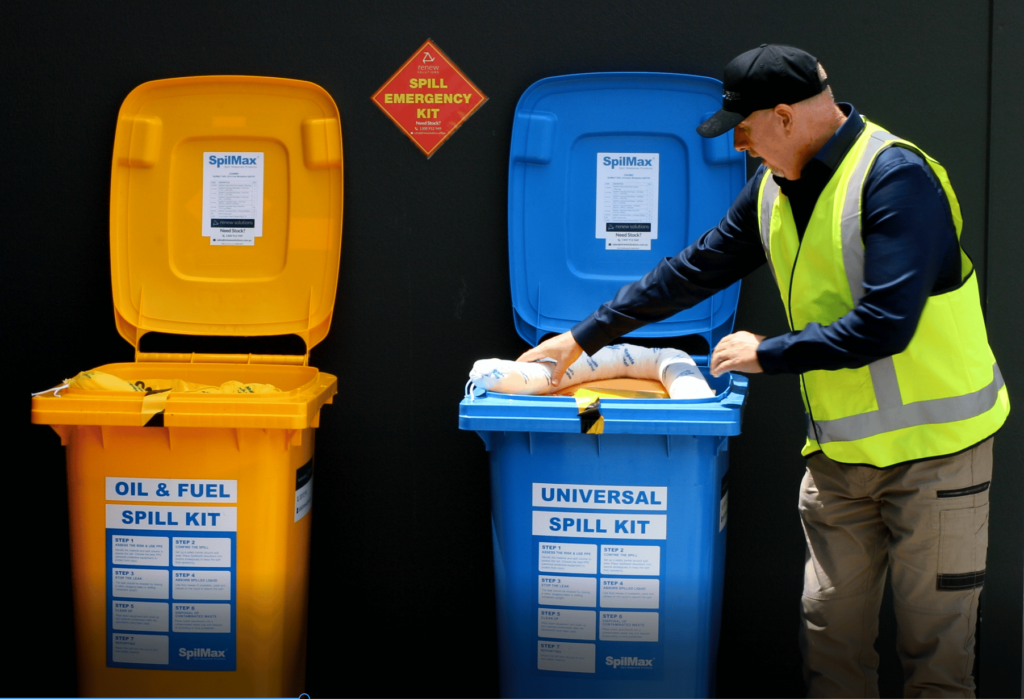
- No spill kit within reach to recover what the bund catches Spill Kits
Frequently asked questions
Does a single 205 litre drum need a bund?
If it holds a dangerous good or an environmentally harmful liquid and it is stored or decanted, yes. A single drum spill pallet or spill tray is usually the proportionate answer.
Is 110 per cent always the right number?
No. It is the most commonly applied figure for a single tank, but AS 1940-2017 uses a layered formula for packaged flammable liquids, several standards work on 25 per cent of aggregate, and South Australian guidance asks for 120 or 133 per cent.
Do I subtract the drums standing inside the bund?
Yes. Displaced volume is not usable capacity, and it is a common audit finding.
What paperwork should I hold?
The capacity calculation, the specification showing sump volume, the compatibility check against the safety data sheet, and inspection records. Auditors ask for the arithmetic, not the brochure.
Book a site assessment to size your bunding correctly

Akuna Services has supplied spill containment across Australia since 2016, is 100 per cent Australian owned and operated, and stocks bunded pallets, collapsible bunds, floor bunding, containment walls, spill decks, berms and trays. Orders placed before 11 am dispatch the same day, nationwide.
If you want the calculation done against your register rather than guessed, book an environmental risk assessment: we will size the containment, match the material to your safety data sheets and put the numbers in writing. Call 1300 912 949 or contact us at 349B Wentworth Avenue, Pendle Hill NSW 2145.