
Resource Hub
Marine spill response: booms, kits and what the rules say
Categories
Share
Quick answer
A marine spill kit is a sealed, buoyant kit built for hydrocarbons on water, holding oil only pads, absorbent booms, a containment boom, personal protective equipment and waste bags. The rules that force you to hold one are narrower than most suppliers imply: an approved SOPEP is required under MARPOL Annex I only for oil tankers of 150 gross tonnage and above and other ships of 400 gross tonnage and above. Every other operator, wharf, marina and workboat is covered instead by workplace emergency planning duties and the water pollution offences in state legislation.
What a marine spill kit is and who needs one
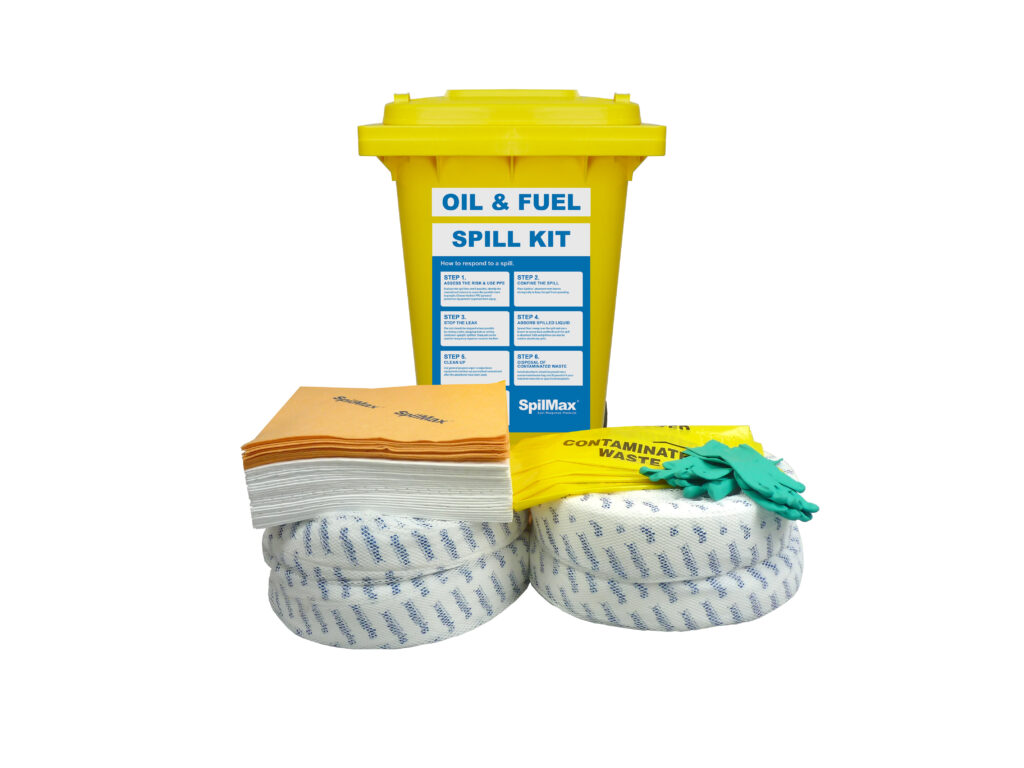
Everything in the kit is chosen on one property: it must work wet and stay on the surface, which rules out clay, floor sweep and untreated organics. Four groups buy them: vessel operators, wharf and berth operators facing a hose failure, marinas and boatyards facing refuelling and slipway runoff, and civil contractors working over water.
SOPEP requirements and Australian marine regulations
SOPEP is the Shipboard Oil Pollution Emergency Plan. Under MARPOL 73/78 Annex I, Regulation 37, an approved SOPEP must be carried by:
- every oil tanker of 150 gross tonnage and above, and
- every ship other than an oil tanker of 400 gross tonnage and above.
Under MARPOL Annex II, Regulation 17, an equivalent plan applies to ships of 150 gross tonnage and above carrying noxious liquid substances in bulk, and the two are commonly combined into a single SMPEP.
In Australia, MARPOL is given effect by the Protection of the Sea (Prevention of Pollution from Ships) Act 1983, administered by AMSA through Marine Orders, principally Marine Order 91, covering regulated Australian vessels, domestic commercial vessels and Australian recreational vessels. Response arrangements sit under the National Plan for Maritime Environmental Emergencies. What this means in practice:
- A recreational boat, a tinnie, a 12 metre workboat or a marina berth does not need a SOPEP. The tonnage thresholds are not met and no Australian law creates the obligation below them.
- The discharge prohibitions still apply. Discharging oil into the sea is an offence under the 1983 Act regardless of vessel size, and state marine pollution law applies in coastal waters.
- On land, the obligation is a workplace one. A wharf, marina or boatyard is a workplace, so the WHS Regulations 2011 duty to prepare, maintain and implement an emergency plan applies.
- Report it. Spills go to AMSA or the relevant state authority. Know which number your crew calls before you need it.
If you operate near the thresholds, confirm your status with AMSA, not with a product catalogue.
Kit contents for vessels, wharves and marinas
| Component | Vessel kit | Wharf or marina kit |
|---|---|---|
| Oil only pads | 50 to 100 | 100 to 200 |
| Oil only absorbent booms | 2 to 4 sections | 4 to 10 sections |
| Containment boom | Short section or none | 10 to 50 metres, plus connectors and anchor line |
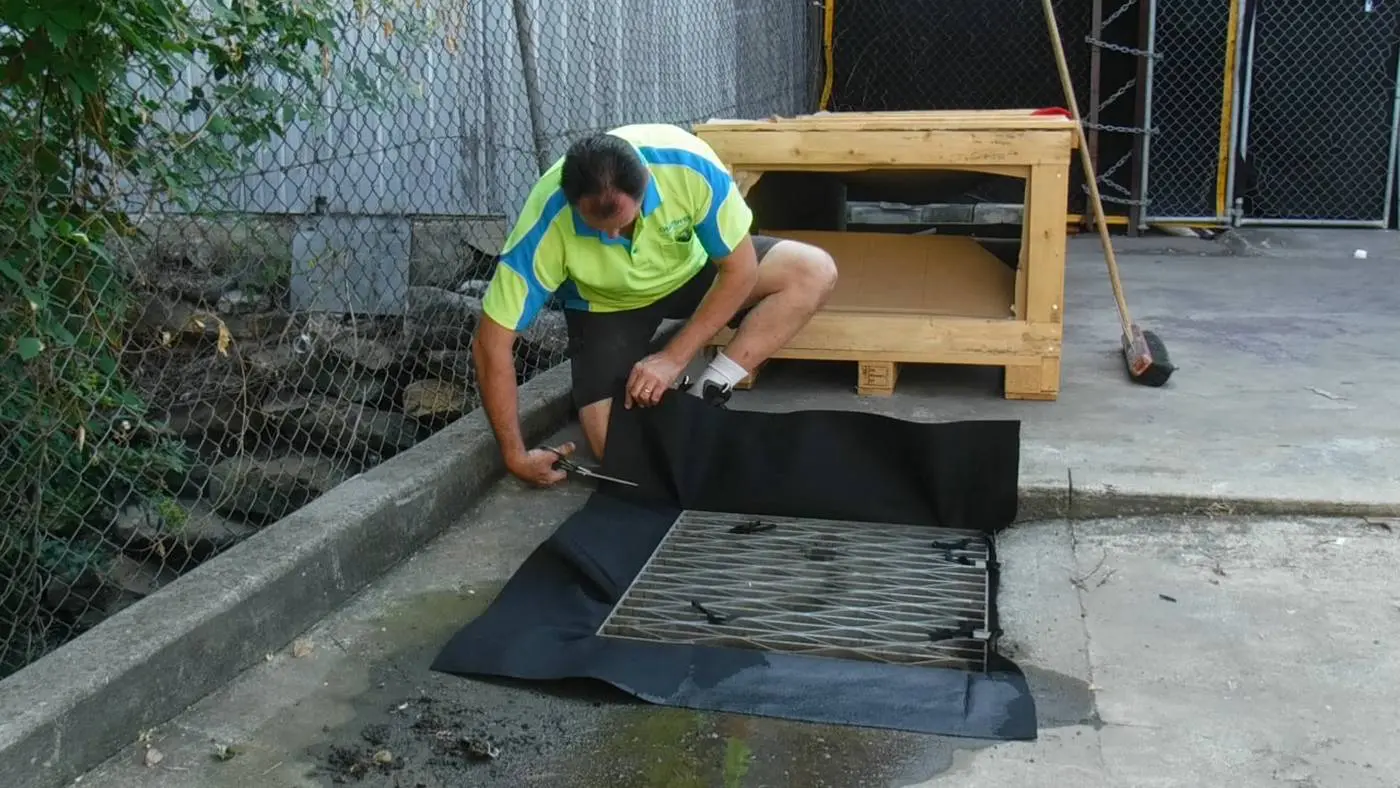
| PPE, waste and tools | Gloves, goggles, coveralls, bags, boat hook | The same plus spares, an overpack drum and a drain cover |
Add a laminated contents list and response procedure to the lid.
Choosing a kit size by vessel and fuel volume
Size against the largest credible spill, not total fuel capacity. On most vessels and wharves that is a hose or coupling failure during transfer, not the loss of a full tank.
Worked example: a vessel bunkers at 200 litres per minute, the transfer is attended, and the crew stops flow in 30 seconds.
Worked example
- 200 litres per minute divided by 60 = 3.3 litres per second
- 3.3 × 30 = 100 litres
That 100 litres is what the kit and boom deployment have to handle. If the transfer is unattended and shutoff takes two minutes, the same arithmetic gives 400 litres and a kit four times the size.
Hydrophobic absorbents that work on water
Marine absorbents are oil only, white, meltblown polypropylene: oleophilic and hydrophobic, so they take up hydrocarbon, shed water and float loaded. Two checks before purchase: load a sample with oil, float it, and confirm it is still on the surface an hour later, then check wet strength, because a sodden pad must not tear when lifted. Absorbent booms are not barriers, so use them inside a containment boom, not instead of one.
Containment booms: fence, solid filled and weighted
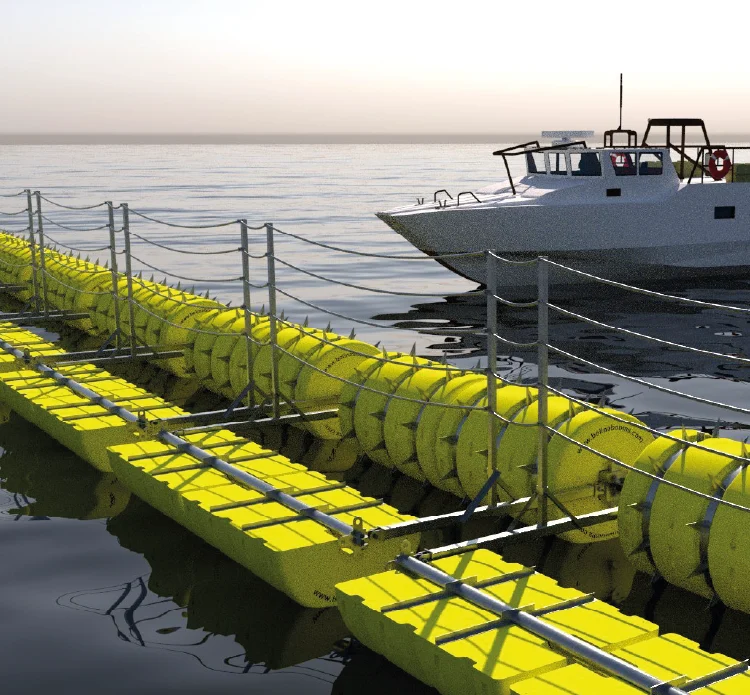
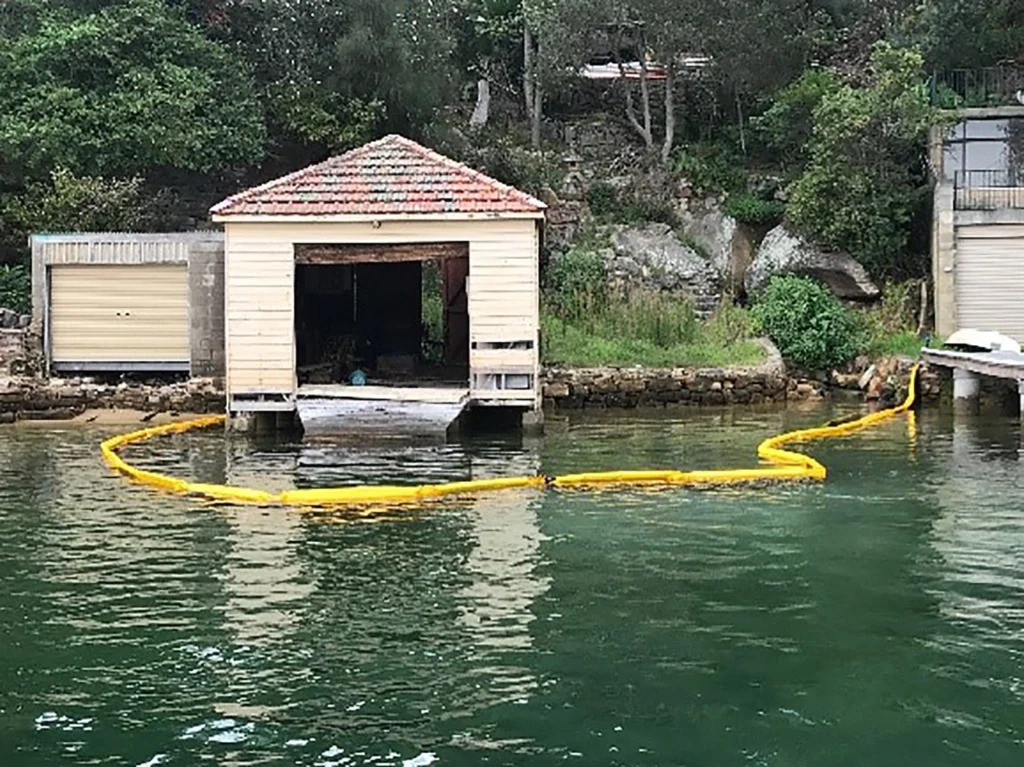
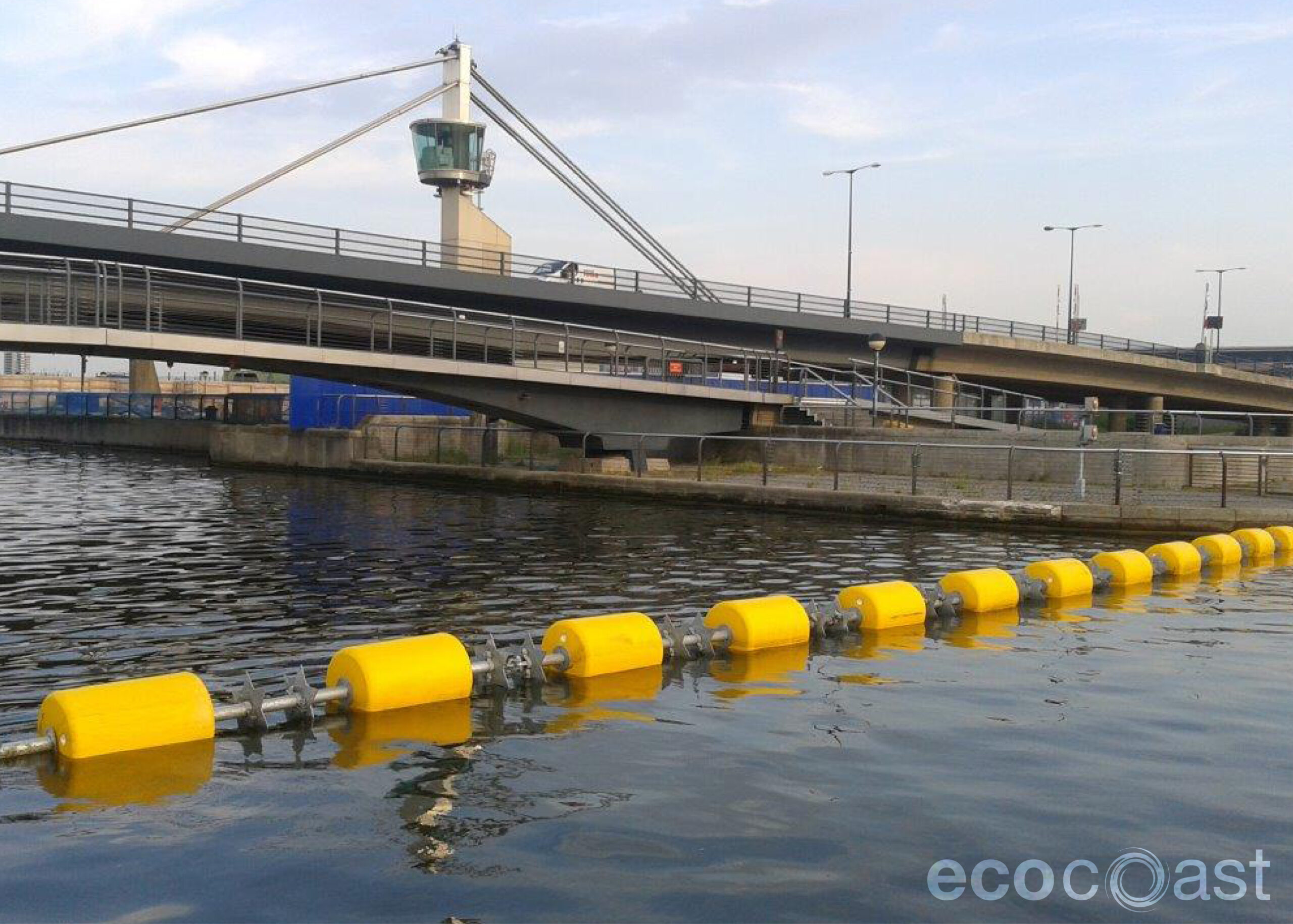
Containment booms hold a slick so it can be recovered. Three constructions cover most Australian work:
- Fence boom. A flat vertical barrier with external flotation and a ballast chain. Compact and quick to deploy, best in sheltered water, prone to planing over in chop.
- Solid filled (flotation) boom. A closed cell foam flotation collar with a weighted skirt and tension member. Holds its shape in chop and current, the usual choice for harbours and long term deployment.
- Weighted or heavy duty boom. Larger freeboard and deeper skirt for exposed, higher energy water.
Match freeboard to wave height, at roughly one part freeboard to two or three parts skirt draft. A boom with freeboard under the wave height is washed over.
Debris and weed booms
Debris and weed booms intercept floating litter, timber, plastics and aquatic weed at stormwater outlets, in canals and across marina entrances. Their skirt passes water and stops solids, a different job to oil containment, so a site with both problems runs separate lines.
Marine barriers for ports, pontoons and safety zones
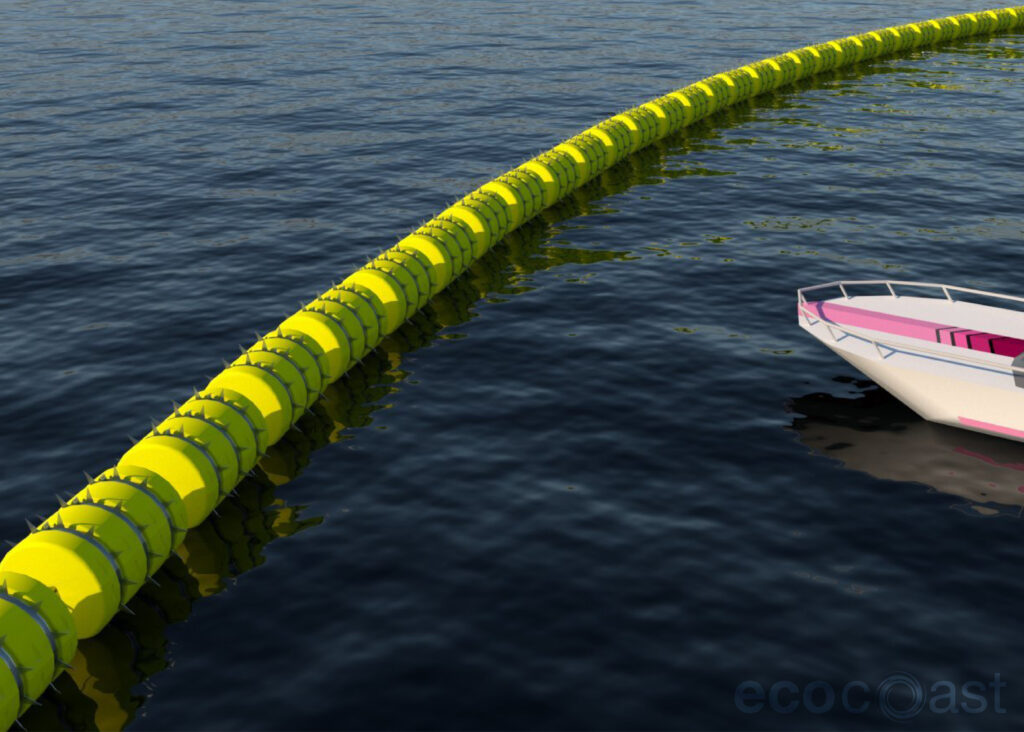
Marine barriers include silt curtains for dredging and pile driving, exclusion and safety barriers around work zones and swim areas, and permanent perimeter systems for ports and pontoons. Specification turns on water depth, tidal range, current and service life, so a two week dredging barrier is a different product to a permanent port installation. Akuna is a direct distributor of Ecocoast.
Deploying a boom in current and wind
The most useful number in marine spill response: oil is entrained under a boom once the relative current across it exceeds roughly 0.7 knots. The boom stays on the surface and the oil goes under it. The fix is geometry, not a bigger boom. Deploy at an angle so the perpendicular component, which is the total current multiplied by the sine of the angle to the flow, drops below the threshold:
Worked example
- In a 2 knot current at 20 degrees: 2 × 0.34 = 0.68 knots, under the threshold.
- The same boom set square across that flow sees the full 2 knots and loses the oil underneath.
Anchor both ends, allow slack for tide, and use a deflection configuration to steer product to a recovery point rather than holding it in open water.
Storage, sealing and inspection on board and on the wharf
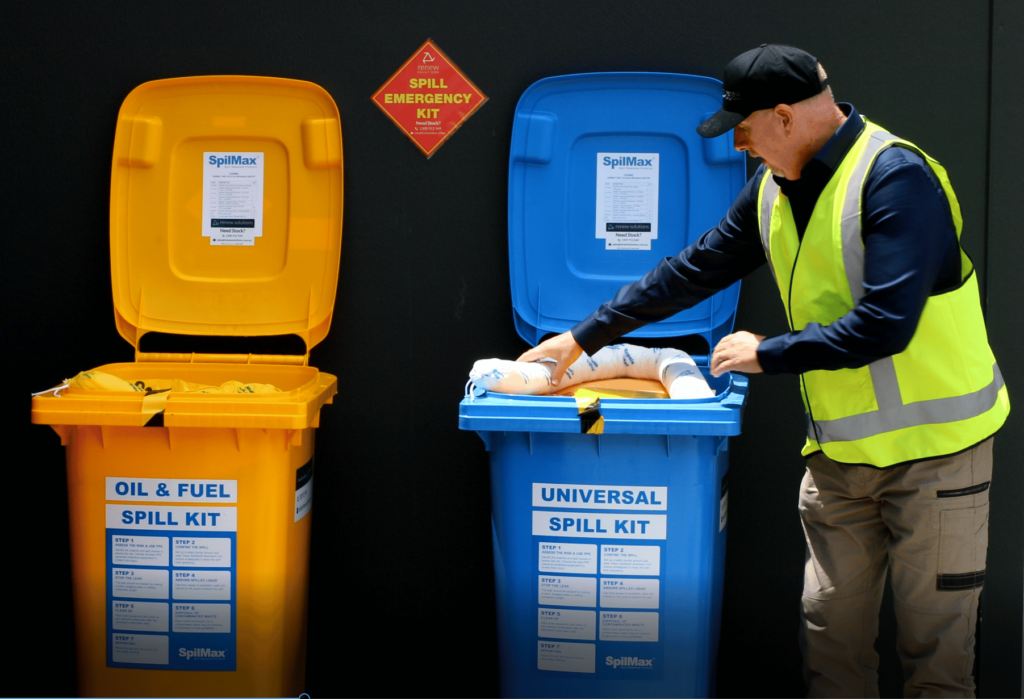
- Store the kit where the transfer happens, not in a locked store at the top of the ramp.
- Use a sealed, UV stable, weatherproof container. Marine kits sit in salt spray and sun, and cardboard inners fail.
- Keep the seal intact and tagged. An opened kit is an audit finding on its own.
- Inspect on a fixed cycle, record it, and restock after use.
- Store booms flaked or reeled, dry and out of UV, with connectors and anchor gear kept with the boom.
Training crews to respond in the first ten minutes
The outcome of a marine spill is decided in the first ten minutes: stop the source, raise the alarm, contain, then recover. A crew that has never opened the kit spends those ten minutes reading the lid.
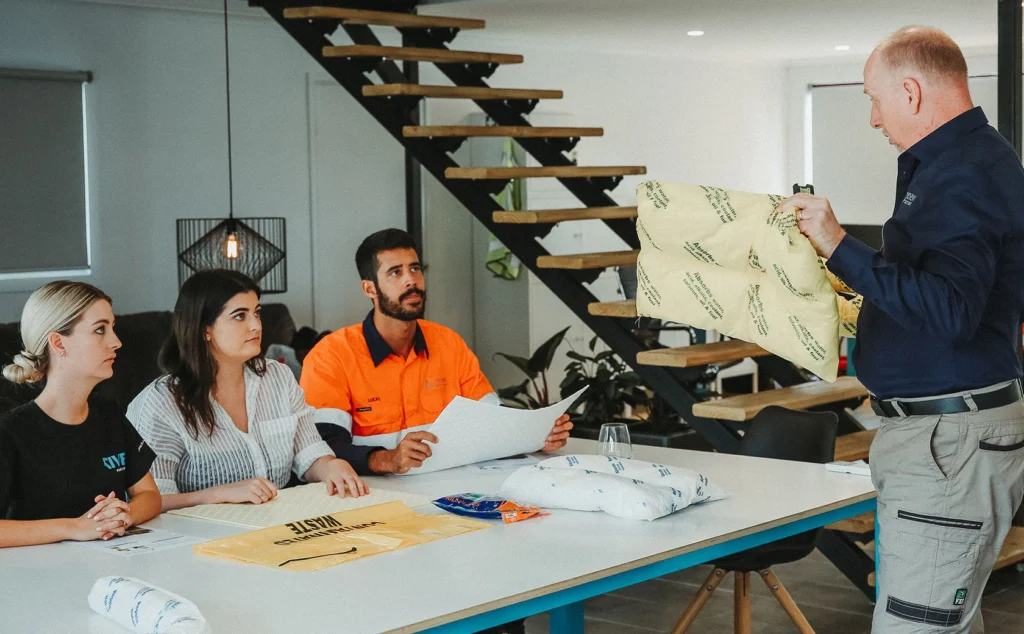
Akuna Services runs a 60 to 90 minute practical spill response workshop at Sydney metro locations on weekdays, for all experience levels, aimed at helping sites meet ISO 14001 compliance requirements. A 30 minute on site toolbox talk on the 7 Step Spill Response Guide refreshes it.
Marine spill kits, booms and barriers dispatched nationwide
Akuna Services is 100 per cent Australian owned and operated, founded in 2016, based at Pendle Hill NSW and servicing sites nationwide. Marine, oil and fuel, universal and chemical spill kits, refills, absorbents, fence booms, solid filled containment booms, debris and weed booms and marine barriers are stocked, with same day dispatch on orders placed before 11 am.
Frequently asked questions
Does my boat need a SOPEP?
Only if it is an oil tanker of 150 gross tonnage or more, or a ship other than an oil tanker of 400 gross tonnage or more. Recreational vessels and most domestic commercial vessels fall under those thresholds, though the discharge and reporting duties still apply.
What is the difference between an absorbent boom and a containment boom?
An absorbent boom soaks up hydrocarbon and has limited capacity. A containment boom is a barrier with freeboard and a weighted skirt that holds a slick and absorbs nothing. Contain first, then recover inside it.
Can I use a normal spill kit on water?
No. Universal absorbents take up water as readily as oil and clay based products sink. A marine kit uses oil only, hydrophobic product that floats when loaded.
Who do I report a marine spill to in Australia?
AMSA or the relevant state or territory maritime or environment authority, depending on where the spill occurs. Response coordination sits under the National Plan for Maritime Environmental Emergencies. Put the number in your emergency plan in advance.
Specifying marine spill gear for a vessel, wharf or marina? Call Akuna Services on 1300 912 949 or browse the marine spill kit, containment boom and marine barrier ranges, dispatched same day on orders placed before 11 am. The spill kit servicing and maintenance program covers auditing and restocking across a whole site.