
Resource Hub
Stormwater drain protection during construction
Categories
Share
Quick answer
Storm water drain covers and seals block pits during spill risk activities, while drain guards, gutter guards and pipe socks strip sediment and hydrocarbons from runoff during rain. Protect every stormwater drain inside the works area before ground is disturbed. The device is set by the drain type, not by preference: grated pits, kerb inlets, sumps and discharge pipes each take a different product, and whichever you use must be named on your erosion and sediment control plan.
Get the pairing right and the wet season passes without an incident report.
Why stormwater drains are the fastest path to a reportable spill
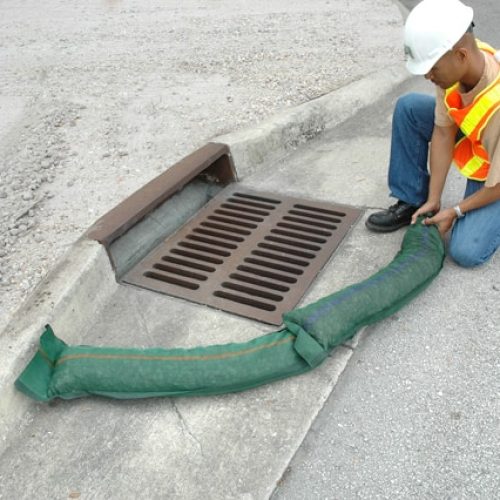
A stormwater pit is a direct, unfiltered connection to a creek, river or harbour. There is no treatment train between the grate and the outfall.
- Travel time is minutes. A 200 L drum failure on hardstand reaches the pit before anyone finds the spill kit.
- The offence is easy to prove. Under the Protection of the Environment Operations Act 1997, ss 120 and 142A, polluting waters or placing material where it can wash into waters is an offence, with equivalents in the Environmental Protection Act 1994 (QLD) and the Environment Protection Act 2017 (VIC).
- Sediment counts as pollution. Turbid runoff from a disturbed site is a breach in its own right, and pit protection is the first thing an auditor checks from the gate.
Choosing drain protection by drain type
| Drain type | Primary risk | Device |
|---|---|---|
| Grated pit on hardstand | Fuel, oil and chemical spill | Drain cover or drain seal |
| Grated pit in a disturbed catchment | Sediment and debris in runoff | Drain guard under the grate |
| Kerb and gutter inlet | Sediment, litter, street runoff | Gutter guard or kerb inlet device |
| Sump or excavation discharge | Turbid dewatering flow | Dewatering bag or pipe sock |
| Pump or hose discharge pipe | Sediment plus hydrocarbons | Pipe sock strapped to the outlet |
Drain covers and mats
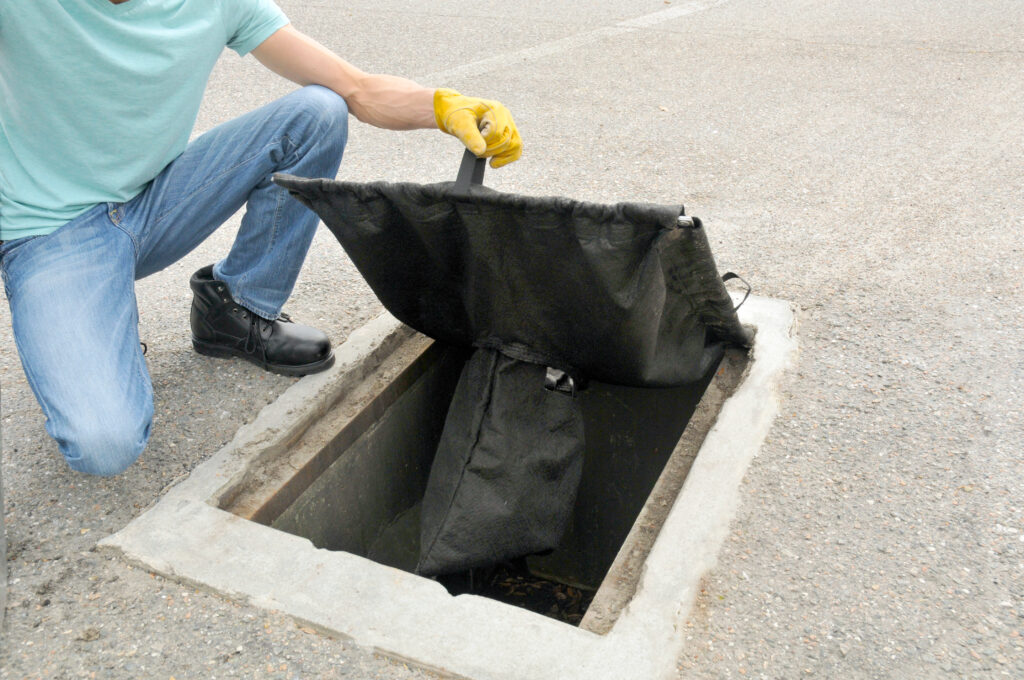
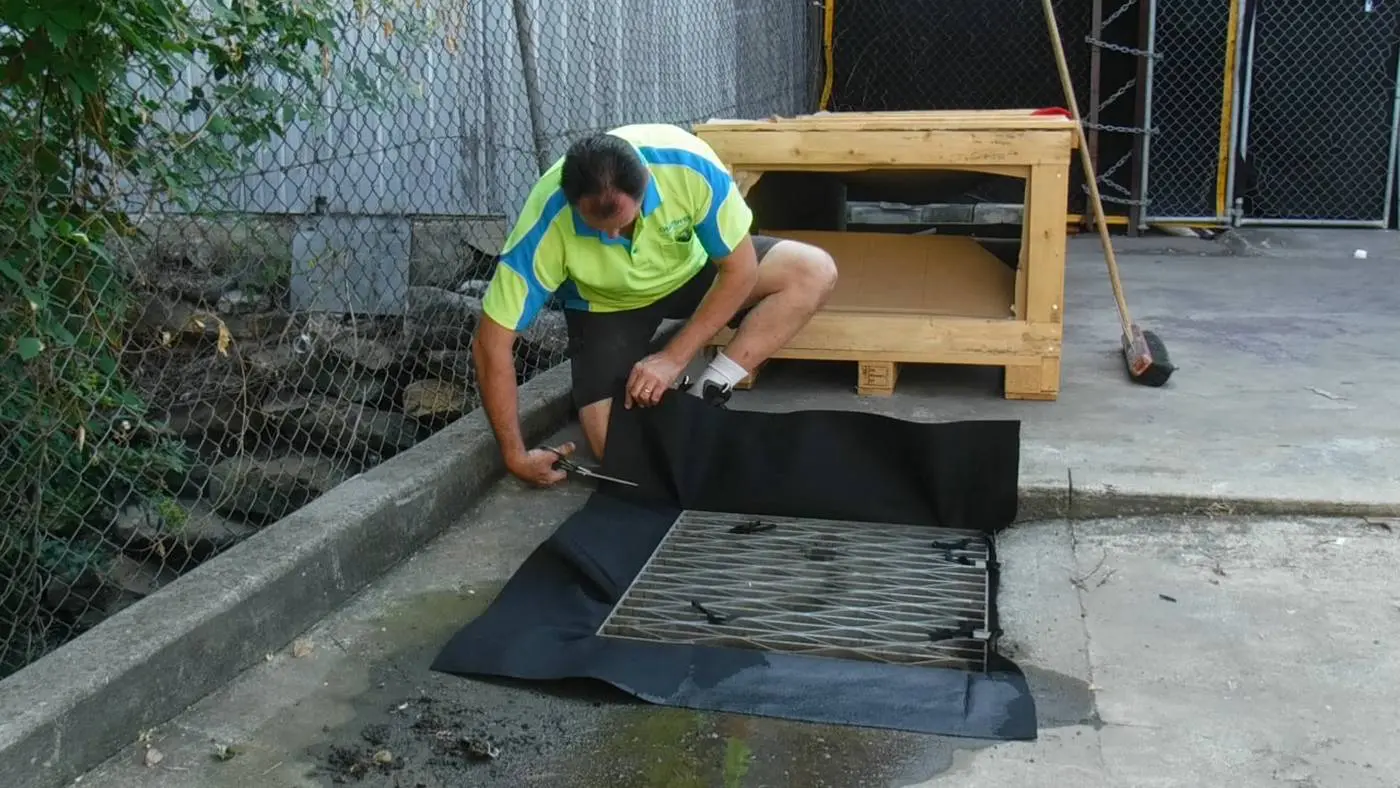
A cover sits on the surface and blocks flow entirely. It is a spill and wash down control, not a rain control, and must come off before a storm or it will flood the pavement.
Choosing storm water drain covers by material
- Weighted PVC covers: 900 gsm high visibility yellow PVC over a 260 gsm non woven geotextile underlay, with gel filled edges that mould to uneven grating. Sizes 0.9 m, 1.2 m and 1.5 m square, four handles, UV stability quoted at up to 5 years.
- Water filled covers: 1.3 m square and 300 mm high when filled, 900 gsm PVC over a 200 gsm polypropylene geotextile underlay, with ballast that conforms to uneven surfaces and holds the cover down in wind.
Drain seals for spill response
A polyurethane drain seal is the fastest positive seal in an emergency, deployed by one person in under a minute. The Ultra-Drain Seal range runs from 0.45 m square at 3 kg to 1.3 m square at 19 kg, with circular models from 304 mm to 1066 mm and rectangles at 1473 mm by 457 mm and 1473 mm by 914 mm.
Sizing arithmetic. The seal must overlap the outside of the grate by at least 152 mm on every side. For a 900 mm by 600 mm grate:
Worked example
- 900 + 152 + 152 = 1,204 mm minimum length
- 600 + 152 + 152 = 904 mm minimum width
That rules out the 1.2 m square unit and points to the 1.3 m square or the 1473 mm by 914 mm rectangle. The standard model suits short deployments, of the order of two hours in the open, because ultraviolet degrades urethane. For longer exposure, specify the Plus model.
Drain and gutter guards for sediment and debris
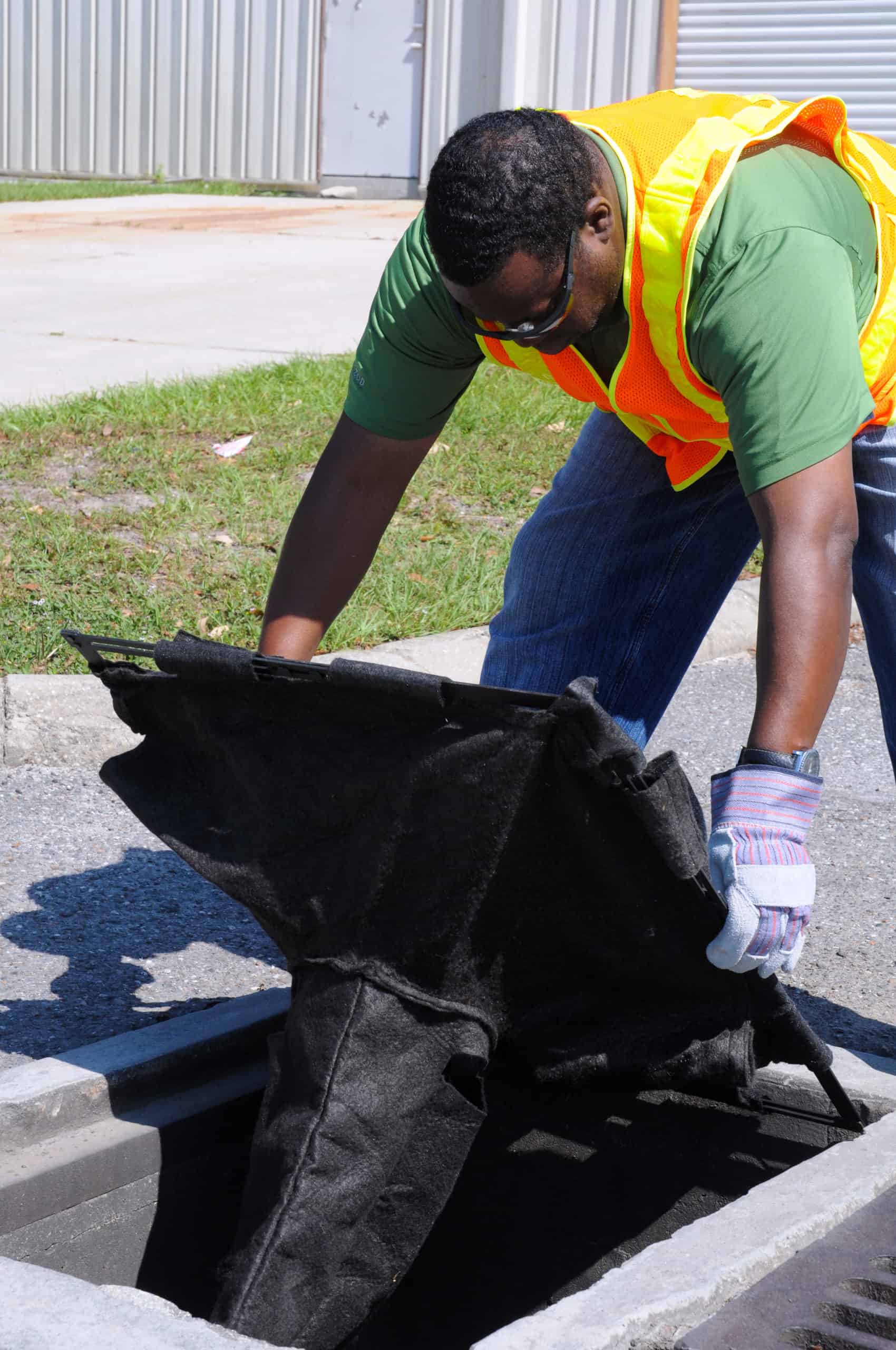
Guards sit under the grate and filter, so flow keeps moving. The Ultra-Drain Guard range uses Ultra-Filter-Tex geotextile:
- Oil and sediment model: 1.2 m by 1.2 m by 450 mm, removing up to 3 litres of hydrocarbons, or 5 litres on the Plus model.
- Trash and debris model: 1.2 m by 0.9 m by 0.4 m, 28 litres of debris capacity.
- Flow: 3,468 L per minute per square metre when new, with overflow ports rated at 909 L per minute so the pit does not surcharge.
Check the flow against your catchment. A 500 m2 hardstand under 20 mm per hour sheds 500 x 0.02 = 10 m3 per hour, or 10,000 / 60 = 167 litres per minute, comfortably inside the overflow rating. Run the same sum for your catchment before assuming a guard will cope.
Where a council specifies a built control instead of a proprietary insert, the drop inlet sediment trap is three layers: heavy gauge wire mesh, geotextile filter fabric, then prewashed 50 to 75 mm gravel. Geotextiles are tested to the AS 3706 series.
Pipe socks and inlet protection
A pipe sock straps to a discharge pipe and filters the flow at the point it leaves the system. The Ultra-Pipe Sock is 1.5 m long in 200 mm by 200 mm with 6 L capacity, or 300 mm by 300 mm with 9 L, and uses Ultra-Filter-Tex to pass high volumes of water while sorbing hydrocarbons.
- It captures sediment plus petroleum, animal and vegetable oils.
- It does not absorb synthetic oils, so check the SDS before relying on it around synthetic hydraulic fluids.
- For high turbidity dewatering, step up to a dewatering bag sized on flow rate Dewatering Bags.
Reusable versus single use protection
| Type | Reusable | Replace when |
|---|---|---|
| Polyurethane drain seal | Yes, wash and air dry | Torn, chemically attacked or deformed |
| Weighted or water filled cover | Yes | PVC punctured or underlay shredded |
| Drain guard | Sediment emptied, unit reused | Hydrocarbon strips saturated |
| Pipe sock or gravel trap | Limited to none | Flow drops or gravel blinds with fines |
Buy reusable where the risk is episodic, single use where the device will be saturated, because a saturated device is a waste item, not an asset.
Trafficable and heavy duty applications
Most covers and seals are not rated for vehicle loads. Where forklifts, trucks or plant cross the pit:
- Confirm the load rating with the supplier, and never assume a spill product is trafficable.
- Where traffic cannot be excluded, use an under grate guard so the grate carries the load.
- Barricade and sign a deployed cover under AS 1319-1994 so nobody drives over a sealed pit.
- Better still, contain at source: under AS 1940:2017 clause 4.4.3(d) a packaged spill compound holds 100 per cent of the largest package plus 25 per cent of the first 10,000 litres stored, so four 205 litre drums need 410 litres of containment Spill Containment on Land.
Deploying protection before the weather turns
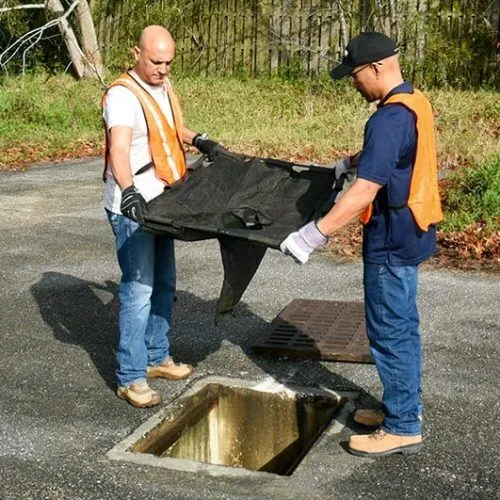
- Map and number every pit, kerb inlet and discharge point in the works area.
- Install sediment protection at mobilisation, before ground disturbance.
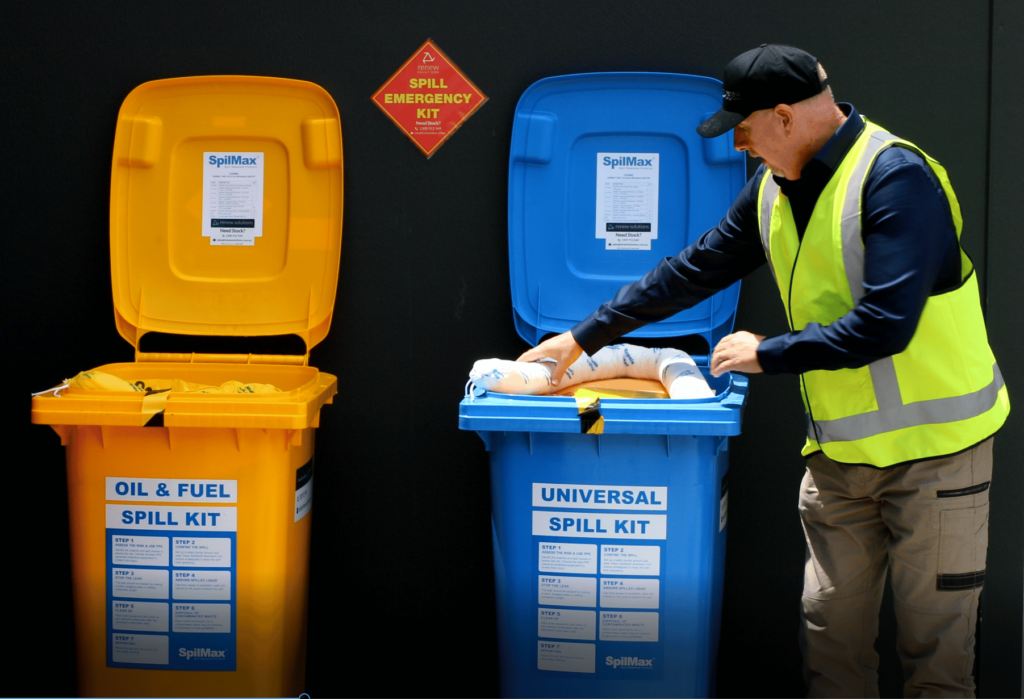
- Stage covers and seals beside the pits they serve, in wall mounted bags rather than a locked store.
- Set a rainfall trigger: at a forecast of 20 mm or more, walk the site, check every device and photograph the walk.
- Remove blocking covers before the storm so the pit can carry flow, leaving filtration devices in place.
Inspection, cleaning and replacement
- Inspect at least weekly, and again before and after every rainfall event.
- Remove sediment well before capacity, because a blinded filter causes surcharge and bypass.
- Wash reusable seals and covers and air dry fully, because a damp folded seal will not seal.
- Replace saturated inserts and dispose of them as contaminated waste under your state waste guidelines.
- Log every inspection against the pit number. That is the paper trail an auditor asks for.
What your erosion and sediment control plan should say about drains
- Every pit, kerb inlet and discharge point marked and numbered on the plan drawing.
- The device type, model and size at each one, with the catchment and flow assumption behind the selection.
- The inspection frequency, rainfall trigger, clean out criteria and the person who owns it by name.
- Where the drain seals live, who deploys them and how an incident is reported Spill Kits.
Full stormwater management range, dispatched nationwide
Akuna Services is 100 per cent Australian owned and operated, founded in 2016, based at 349B Wentworth Avenue, Pendle Hill NSW 2145 and servicing sites nationwide, with same day dispatch on orders placed before 11 am.
The stormwater range covers drain covers, drain seals, drain and gutter guards, pipe socks, debris booms and weed booms, backed by silt curtains, silt socks, dewatering bags and concrete washout bunds. Brands include Chatoyer, SpilMax, DrainSAFE, Ecocoast, Ultratech and Accumax Global. Stormwater product installation is available if you would rather the first deployment was documented for you.
Frequently asked questions
Can I leave a drain cover on during rain?
No. A blocking cover stops all flow and floods the pavement. Covers and seals are for spill risk work and emergencies. For rain, use a filtration device that passes water while holding sediment and hydrocarbons.
What size drain seal do I need?
Allow at least 152 mm of overlap beyond the grate on every side. A 900 mm by 600 mm grate needs 1,204 mm by 904 mm minimum, so the practical choice is a 1.3 m square seal or a 1473 mm by 914 mm rectangle.
Will a drain guard cope with a storm?
Check the arithmetic. A 500 m2 catchment at 20 mm per hour produces about 167 litres per minute against overflow ports rated at 909 litres per minute. Larger catchments need a control upstream, not a bigger insert.
Do pipe socks handle hydraulic oil?
They sorb petroleum, animal and vegetable oils, but not synthetic oils. Check the safety data sheet for the fluid on your plant first.
Mobilising a site or watching the wet season forecast? Browse Stormwater Management for covers, seals, guards and pipe socks, pair them with Silt and Sediment Control, and call 1300 912 949 to have the selection checked against your erosion and sediment control plan.