
Marine Barriers
Showing 13–13 of 13 results
-
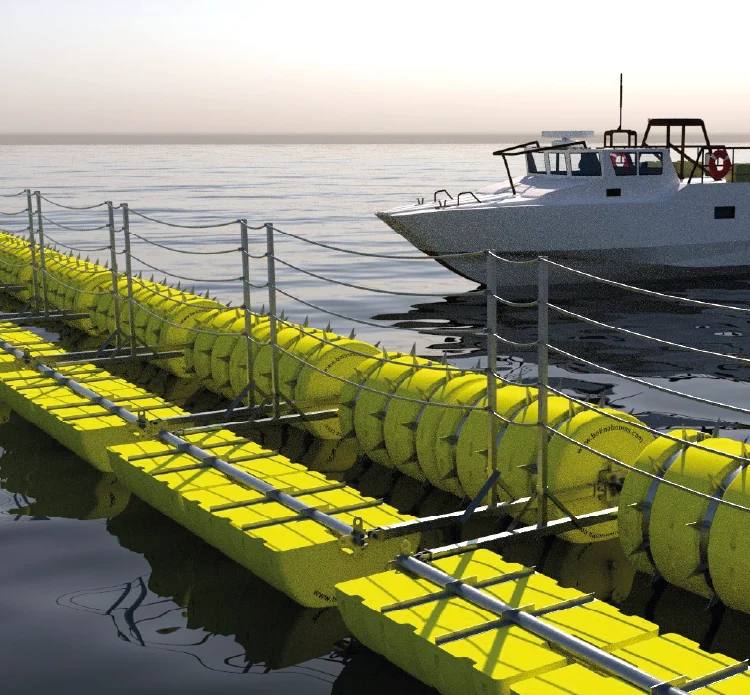
Security Booms Extreme
Price available upon request
Extra Information
Marine Barriers
Purpose-Built Marine Barriers for Australian Waterways
Marine barriers are floating boom systems that separate people, vessels and floating material from the water around them. Anchored in place, they enclose a swimming area, hold a security line across a harbour entrance, deflect debris from an intake or contain a spill on open water.
Akuna Services supplies marine barriers for safety, security and environmental duty nationwide: swimming and shark barriers, watercraft and pontoon booms, security booms, and debris, weed and containment booms. We are a direct distributor of Ecocoast, Australian owned and operated since 2016, with same day dispatch before 11 am.
3 jobs
Safety, security and environment
Ecocoast
Direct distributor
11 am
Order cut off for same day dispatch
2016
Australian owned and operated since 2016
On this page
- 01What Marine Barriers Do and the Three Jobs They Cover
- 02Our Range of Swimming, Shark and Pontoon Barriers
- 03Watercraft Safety Booms and Security Barriers
- 04Debris Booms, Weed Booms and Containment Booms
- 05Marine Barriers for Councils, Ports and Marinas
- 06Beaches, Swim Enclosures and Public Waterways
- 07Floatation, Ballast and Anchoring That Holds
- 08Safer Water for Swimmers and Cleaner Water for Everyone
- 09Ecocoast Marine Barriers Supplied Australia-Wide
- 10Choosing a Barrier for Depth, Current and Exposure
- 11FAQs
What Marine Barriers Do and the Three Jobs They Cover
Our range covers three distinct jobs. Most buyers need one, not all three, so settle which problem you are solving before you look at product.
| Job | What it does | Products |
|---|---|---|
| Safety | Keeps swimmers in, keeps hazards out | Swimming and shark barriers, jellyfish nets, beach, ball and rope barriers, watercraft and pontoon booms |
| Security | Controls access to the water and the assets on it | Security booms, exclusion and demarcation booms, log screen booms |
| Environment | Captures, deflects or contains what is in the water | Debris booms, weed booms, weighted and solid filled containment booms, fence booms |
All three use a float, a tension member and a net, skirt or screen, but are engineered differently. A safety barrier is built to be seen and to forgive contact. A security boom resists a determined approach. An environmental boom holds material without letting it dive underneath.
Our Range of Swimming, Shark and Pontoon Barriers
The safety range covers public and commercial bathing:
- Ecobarrier Swimming Safety Barriers: full enclosures for beaches, lagoons and resort frontages.
- Bolina Shark Safety Net Booms: netting suspended from a float to exclude sharks.
- Ecobarrier Jellyfish Safety Nets: fine mesh excluding stingers while keeping water exchange.
- Bolina Beach Safety Booms and Beach Safety Net Booms: demarcation and netted variants.
- Bolina Ball Safety Barriers and Rope Safety Booms: lighter lines for low exposure sites.
- Ecofloat Pontoon Barriers: fendering and separation around pontoons and jetties.
Send us depth, tidal range and fetch: a netted barrier carries far more load than a rope line, and we size floats and anchoring to match.
Watercraft Safety Booms and Security Barriers
Bolina Watercraft Safety Booms keep powered craft out of swimming areas, off shallows and away from moored assets. They are built for repeated contact, with a float profile that deflects a hull along the line rather than stopping it.
Security Booms Advanced suit a security plan rather than a safety plan, setting a physical line at a port entrance, fuel berth, intake or defence facility, specified around approach speed and standoff. For land side protection, see our impact protection and Sidewinder cable protection ranges.
Debris Booms, Weed Booms and Containment Booms
Permanent Debris Booms are a long term fixture on rivers, canals, outfalls and harbour basins, collecting litter at one serviceable point. Weed Booms do the same for aquatic vegetation through the wet season. Weighted and Solid Filled Containment Booms pair a closed cell float with a ballasted skirt so hydrocarbons cannot escape beneath.
Here is the arithmetic that catches people out. A boom straight across a 100 metre channel is overwhelmed.
Worked example
- Set at 45 degrees to the flow it needs 100 ÷ cos 45, roughly 141 metres of boom, but effective current across the skirt drops to about 0.7 of channel velocity.
- Order for the angle, not the width.
Marine Barriers for Councils, Ports and Marinas
Councils, ports, marinas and utilities carry most of the demand, each with a different driver:
- Local government: swim enclosures at tidal baths, debris booms on urban creeks, event demarcation.
- Ports and harbours: security booms at berths, log screens at intakes, containment for bunkering.
- Marinas: pontoon barriers and separation between fairways and public access.
- Utilities: intake protection, weed and debris control on waterways and dam forebays.
- Mining, industrial and defence: exclusion on process water, containment where runoff collects.
Each sits inside a plan someone has to defend, so the barrier needs a specification sheet, an installation record and an inspection regime. We supply all three.
Beaches, Swim Enclosures and Public Waterways
Public bathing is where the duty of care is heaviest. A person conducting a business or undertaking carries obligations under the WHS Regulations 2011, and for a public enclosure those extend to the people in the water.
A swim enclosure is rarely a straight line.
Worked example
- A 60 metre frontage with 20 metre returns at each end needs 60 + 20 + 20.
- That is 100 metres of barrier before anchoring.
High visibility colour and reflective elements let the line be seen in low light, which makes it a control rather than a hazard.
Floatation, Ballast and Anchoring That Holds
Most marine barrier failures are anchoring failures. The float survives and the run ends up on the beach, because the mooring was undersized for the day.
Our barriers use closed cell floatation that will not waterlog if damaged, UV and corrosion resistant components, and a continuous tension member so load transfers to the anchor points, not one connection.
Worked example
- A chain scope of 3:1 in 4 metres of water means 12 metres of chain per anchor point.
- A 2 metre tidal range is calculated on 6 metres, not 4.
Safer Water for Swimmers and Cleaner Water for Everyone
We all share responsibility for the water at the bottom of the catchment. A debris boom on a suburban creek stops the plastic that turns up on the beach twenty kilometres downstream. Akuna supports The Ocean Cleanup Project.
The benefit stacks in three places. Safety, because a netted enclosure is a defensible control rather than a sign on a fence. Compliance, because the specification and inspection record are evidence for an auditor. Cost, because recovery at one point is a fraction of remediation once material disperses.
Ecocoast Marine Barriers Supplied Australia-Wide
Akuna is a direct distributor of Ecocoast, and stocks Chatoyer, SpilMax, DrainSAFE, Ultratech and Accumax Global across the wider range. Direct distribution means we specify from the manufacturer’s engineering data and configure to the site, not to the nearest standard item.
Products ship Australia wide with same day dispatch before 11 am. Onsite services, including installation, environmental risk assessment and in person training, are primarily New South Wales, with limited coverage into Queensland and Victoria through contractors and partners. Call 1300 912 949 and we will come back with a configuration, not a price alone.
Choosing a Barrier for Depth, Current and Exposure
Five questions to settle before you request a quote:
- 1What is the job? Safety, security or environment. This sets the product family and everything downstream.
- 2What are the conditions? Depth at lowest and highest tide, tidal range, current and fetch.
- 3What is the run length? Measure the crossing, then add for deflection angle and returns.
- 4Permanent or temporary? Permanent installs justify heavier floats and fixed anchoring. Seasonal barriers must be recoverable.
- 5Who maintains it? Service access drives the collection point and connectors.
Send those answers with a site photo and we will specify floats, skirt or net depth, anchoring and connectors as one package.
FAQs
What are marine barriers used for?
They restrict access to sensitive areas, guide vessel traffic, exclude sharks and jellyfish, mark bathing and hazard zones, and capture floating debris, weed and hydrocarbons. The three jobs are safety, security and environment, each using a different build.
How long do marine barriers typically last?
Well specified marine barriers generally last five to fifteen years. Lifespan depends on material quality, exposure to UV, salinity and wave action, and how regularly the barrier is inspected. Anchoring hardware usually needs attention well before the floats do.
What is the difference between a debris boom and a containment boom?
A debris boom intercepts floating solids such as litter, timber and vegetation and deflects them to a collection point. A containment boom has a ballasted skirt that seals against the surface so hydrocarbons cannot pass under it. They are not interchangeable.
Can marine barriers withstand harsh weather?
Yes, when the barrier and its anchoring are specified for the site’s real conditions, not average ones. In extreme events some barriers are best temporarily removed or reinforced, so build an inspection and response procedure into the site plan.
How do I know what my site legally needs?
That depends on your waterway authority, your council or port approvals, and the obligations applying to your operation, including the WHS Regulations 2011 and any ISO 14001 system you are certified against. Our environmental risk assessment reviews the site and documents the required controls.
Want to book a spill training session?
Get in touch with our expert team and we will guide you through the process.