
Resource Hub
Choosing a dewatering bag: flow rate and sediment sizing
Categories
Share
Quick answer
A dewatering bag is matched to a pump by filtration fabric area, allowing roughly one square metre of fabric for every 1 to 2 litres per second of actual pump output. Fabric area matters more than footprint, because a bag’s clean water flow rate collapses once the fabric blinds with sediment. Then match the fabric to the sediment: a 260 gsm non woven geotextile at around 180 micron retains sand and gravel reliably, partially retains fine sand, and will not retain silt or clay, which need settlement or flocculation instead.
Get either wrong and you blow a seam on day one, or discharge water that fails a turbidity check.
What a dewatering bag does
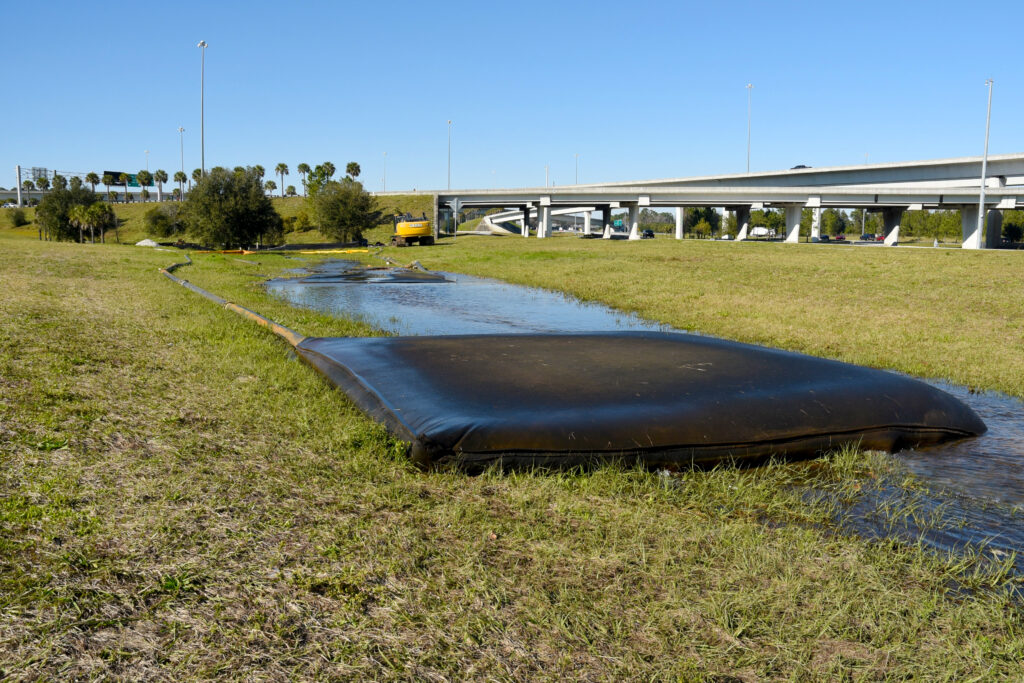
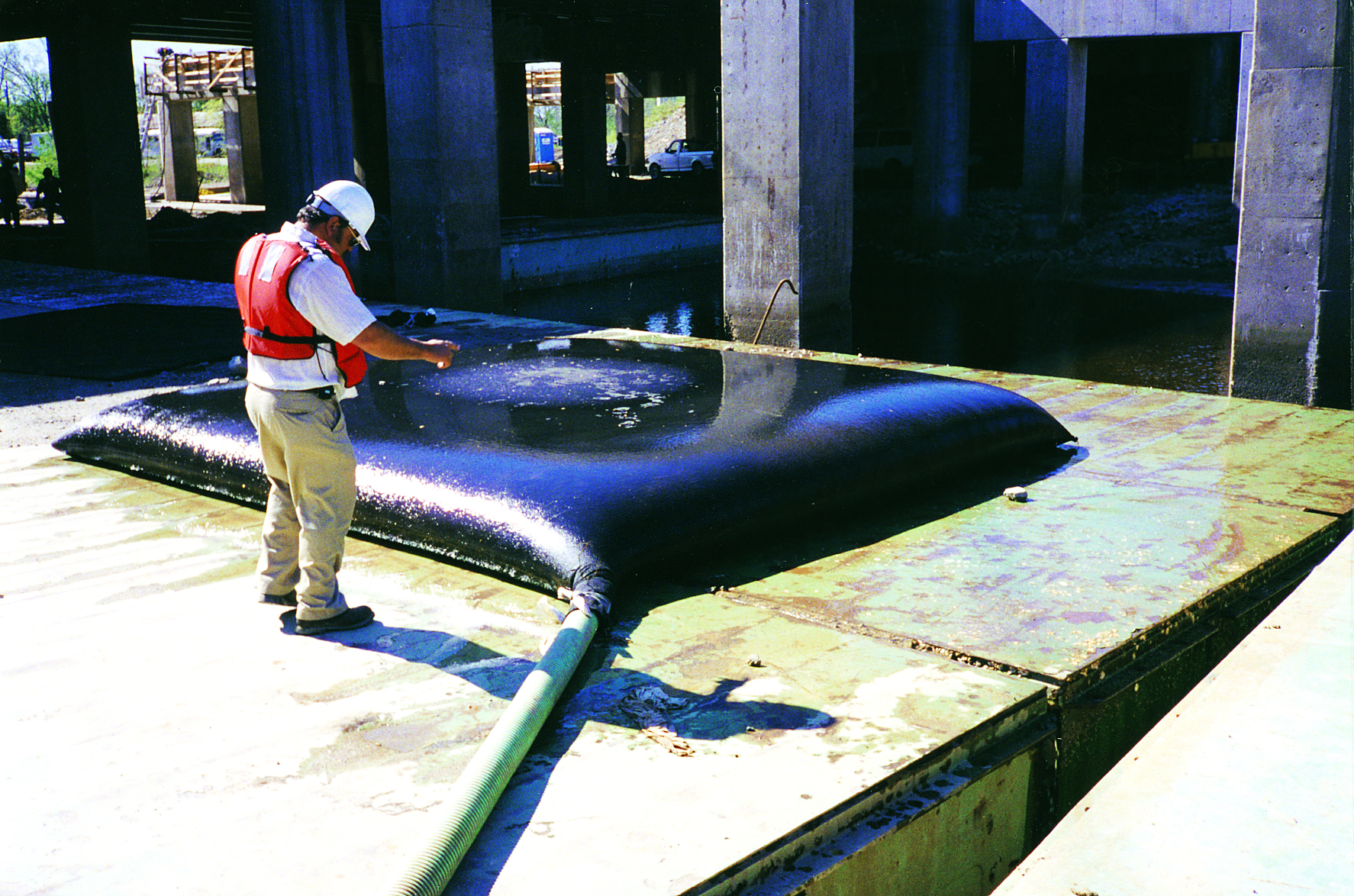
A sewn geotextile filter bag that a pump discharges into. Water passes out through the fabric while sand and coarse sediment stay inside, and when full the bag is lifted or cut open and the solids disposed of. Filtration happens across the entire fabric area, not at the outlet, which is why fabric area controls flow and a larger footprint does more than a tighter pore size.
When to use a dewatering bag on site
Use one where you are pumping sediment laden water dominated by sand to a stable, vegetated discharge point: excavations, trenches and piling bores after rain, cofferdams and shoring boxes, sediment basins and sumps between storms, and hydro excavation slurry.
It is the wrong control where the water is clay dominated, where an aggressive turbidity limit applies, or where dissolved contaminants are present.
Matching the bag to your pump flow rate
Published fabric flow rates are clean water figures, which is where most selections go wrong. The Akuna range uses a 260 gsm non woven geotextile rated at 60 litres per square metre per second. In the field, sediment blinds the fabric within minutes and the practical rate settles near 5 to 10 per cent of that.
A 100 mm pump at 20 L/s: a bag with 6.8 m2 of fabric gives 6.8 x 60 = 408 L/s clean, derated at 5 per cent to 20.4 L/s, matching with almost no margin.
A 50 mm pump at 6 L/s: a 1.2 m x 1.2 m bag has about 2.9 m2 across both faces, but the underside blinds early, so allow 1.6 m2 effective. That gives 96 L/s clean, derated to 4.8 L/s, so move up a size.
| Discharge hose | Typical output | Bag footprint | Approx fabric area |
|---|---|---|---|
| 50 mm (2 inch) | 4 to 8 L/s | 1.2 m x 1.2 m | 2.9 m2 |
| 75 mm (3 inch) | 8 to 15 L/s | 2.5 m x 1.5 m | 7.5 m2 |
| 100 mm (4 inch) | 15 to 25 L/s | 2.5 m x 1.5 m | 7.5 m2 |
Above 25 L/s, manifold the discharge across two or more bags. Throttle the pump, not the bag: forcing a high output pump into an undersized bag builds pressure until a seam lets go.
Sediment retention: fabric weight and micron rating
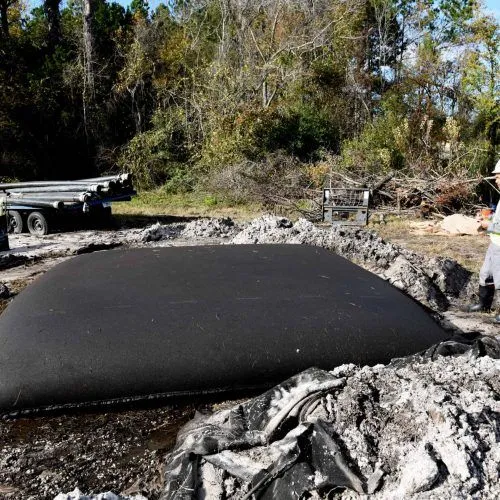
Fabric weight in gsm is a strength specification: a 260 gsm non woven geotextile resists abrasion from sand inside the bag, the load of a full bag being dragged and UV exposure across a wet season. It does not determine what you retain. Pore size in microns, also given as apparent opening size, determines retention, and tightening it costs flow.
| Sediment fraction | Particle size | Retention at 180 micron |
|---|---|---|
| Gravel and coarse sand | Above 200 micron | Complete |
| Fine sand | 60 to 200 micron | Partial, improves as the fabric cakes |
| Silt | 2 to 60 micron | Largely passes |
| Clay | Below 2 micron | Passes |
That is the honest limit of the technology: a bag is a sand and gravel control and will not, on its own, bring clay rich water to a low turbidity limit. Where fines are the problem it is one stage in a train: settle, flocculate where the consent allows, pump to the bag, then discharge to a vegetated buffer. Geotextile properties are tested to the AS 3706 series.
Available sizes and capacities
| Product | Dimensions | Neck |
|---|---|---|
| Chatoyer dewatering bag | 1.2 m L x 1.2 m W | 100 mm |
| Chatoyer dewatering bag | 2.5 m L x 1.5 m W | 200 mm |
| Chatoyer dewatering cube | 0.9 m x 0.9 m x 1.1 m H | 200 mm on top |
All are 260 gsm non woven geotextile at 180 micron, with 50 mm or 100 mm camlock or pipe clamp inlets and double stitched necks. Where the discharge carries hydrocarbons too, the Ultra-Dewatering Bag oil and sediment model handles 17 litres per second, carries 6.8 m2 of UV resistant fabric and holds 1 m3 or 1,950 kg of solids.
How to position and support the bag
- Level, stable ground. A bag on a slope migrates as it fills and loads one seam.
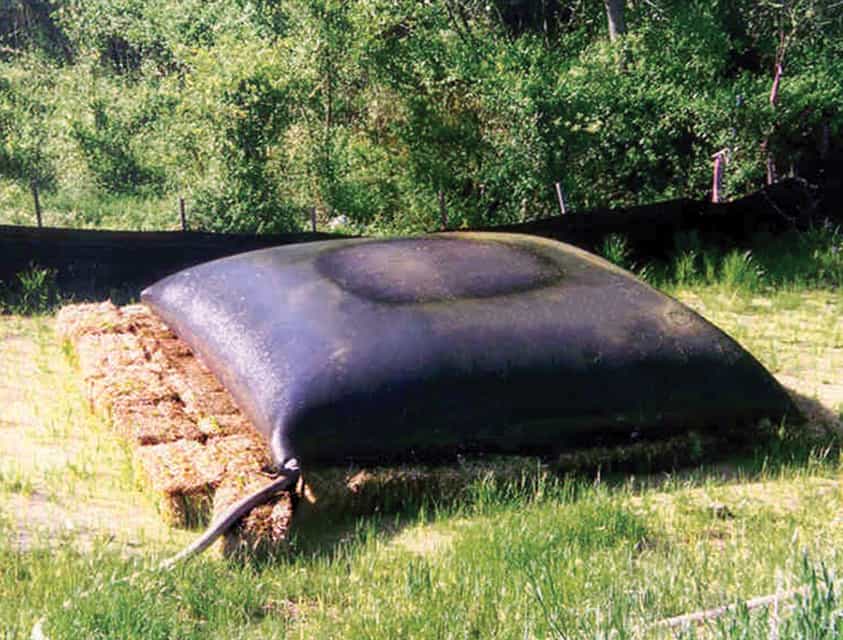
- On straw bales, aggregate or a gravel pad so water escapes the underside. A bag flat on clay loses its bottom face entirely.
- Vegetated ground downslope, at least 15 to 20 metres from any pit, kerb inlet or watercourse.
- Hose secured and supported with the camlock engaged, and the bag reachable by a machine.
Discharge, ground protection and outflow checks
Outflow is filtered, not treated.
- Spread it across a vegetated buffer or level spreader rather than letting it channel
- Protect erodible ground with a mat, and back the bag up with drain protection at the nearest pit Stormwater Management
- Check outflow clarity at 5 minutes, then hourly
Inspection, replacement and disposal
| Trigger | Action |
|---|---|
| Hourly during pumping | Check outflow clarity, neck, seams and ground beneath |
| Bag firm, flow slowing | Approaching capacity, plan the changeover |
| Two thirds of solids capacity | Replace, do not run to failure |
Never lift a full bag by the neck. Dispose of retained solids to a licensed facility per your jurisdiction’s waste classification and keep the docket.
Dewatering bags compared with silt socks and curtains
| Control | Best for |
|---|---|
| Dewatering bag | Filtering pumped discharge leaving a pump |
| Silt sock | Overland flow at the perimeter, kerb inlets, contour breaks |
| Silt curtain | Enclosing works in still or slow moving water |
| Sediment fence | Sheet flow at the boundary of the disturbance footprint |
Run several at once.
Council and state sediment control requirements
- Your erosion and sediment control plan must show dewatering as a control, with the discharge location marked.
- Consent conditions commonly name a discharge limit as total suspended solids or turbidity, and a bag alone will not always get there.
- NSW sites are assessed against Managing Urban Stormwater: Soils and Construction, the Blue Book. Elsewhere, state guidance and IECA Australasia best practice apply.
- Pollution of waters offences apply regardless of your plan, and attach to the occupier as well as the contractor.
Common mistakes that blow a bag out
- Running a 100 mm pump at full duty into a bag sized for 50 mm discharge
- Placing the bag on bare clay, so the underside never filters
- Siting it uphill of a kerb inlet with no buffer
- Running to failure instead of replacing at two thirds capacity
Specifications and freight to your site
Akuna stocks all three formats plus the oil and sediment model, alongside silt curtains, silt socks and concrete washout bunds. Orders placed before 11 am are dispatched the same day, and Akuna services sites Australia wide from Pendle Hill in NSW. Akuna is 100 per cent Australian owned and operated and has supplied compliance products since 2016.
Frequently asked questions
How do I work out what size dewatering bag I need?
Start from actual pump output and allow about 1 square metre of fabric per 1 to 2 litres per second. A 50 mm pump at 4 to 8 L/s suits a 1.2 m x 1.2 m bag, a 75 mm or 100 mm pump to 20 L/s suits a 2.5 m x 1.5 m bag, and above 25 L/s manifold across two bags.
What micron rating do I need?
For sand and coarse sediment, 180 micron is the practical standard. If your water is silt or clay dominated, no rating reaches a low turbidity limit alone.
Does fabric weight change what the bag filters?
No. The 260 gsm figure governs abrasion resistance, seam strength and UV life, while pore size determines retention.
Can I discharge straight to a stormwater drain after the bag?
No. Discharge to stable vegetated ground at least 15 to 20 metres from any pit or watercourse, because discharging pumped water to stormwater is an offence in every Australian state.
Akuna Services supplies dewatering bags, silt curtains, silt socks and concrete washout bunds nationwide, with same day dispatch on orders placed before 11 am. To have the flow calculation documented for an erosion and sediment control plan, book an environmental risk assessment or call 1300 912 949.